Contents
Scroll to:
 Igor V. Bukhtiyarov,
Ludmila V. Prokopenko,
Nikolay N. Courierov,
Alla V. Lagutina,
Ilia Z. Dzhikiya
Igor V. Bukhtiyarov,
Ludmila V. Prokopenko,
Nikolay N. Courierov,
Alla V. Lagutina,
Ilia Z. Dzhikiya https://doi.org/10.47470/0016-9900-2026-105-2-102-109
EDN: lnlcpp
Scroll to:
Introduction. The noise under the aircraft fly pass is the one of many sources of noise in residential areas. The domestic regulatory documentation concerning noise measurements and assessment in residential areas contains insufficient and even contradictory requirements which fail to allow determining correct acoustic parameters and the impact of aircraft noise assessment on comfortable living conditions and public health. It is necessary to measure the equivalent and maximum sound levels A for reference intervals of 15 minutes during representative observation periods during the day and night, or for the entire 24 hours.
With the introduction of SanPiN 1.2.3685–21 and the cancellation of SP 2.1.8.3565–19, the requirements for determining of the possibility of placing capital construction facilities in the seventh subzone of the airfield territory are determined by the Methodology for establishing the seventh subzone of the airfield territory, calculating and assessing risks to human health, approved by Order of the Federal Service for Supervision in Protection of the Rights of Consumer and Man Wellbeing (Rospotrebnadzor) dated 12/07/2022 N 664. This order and orders of Rospotrebnadzor dated 02/28/2024 No 150 and No. 963 dated 05.12.2024 on amendments to the Methodology do not address the problems of the correctness of measurements of normalized and auxiliary parameters of the aircraft noise.
Materials and methods. The requirements of regulatory and methodological documents on measurements of normalized noise parameters have been analyzed. Direct measurements of sound levels were taken using digital instruments. The measurement results processing were based on the analysis of sound level chronograms, which were processed using special software.
Results. The rules for determining the level of background noise and the duration of aircraft noise have been proposed. Proposals for improving the requirements of MUC 4.3.3722–21 have been developed and substantiated.
Limitation. The study is limited to the scope of MUC 4.3.3722–21.
Conclusion. Aircraft noise in residential areas measuring technology with chronograms of sound levels analyzing for hygienic control and justification of the possibility of placing capital construction facilities in the seventh subzone of the airfield area based on a predictive assessment of the sound level has been developed and scientifically substantiated.
Compliance with ethical standards. The study does not require a biomedical ethics committee opinion.
Contribution:
Bukhtiyarov I.V. – approval of the final version of the article, responsibility for the integrity of all parts of the article;
Prokopenko L.V. – concept and design of the study, editing, approval of the final version of the article, responsibility for the integrity of all parts of the article;
Courierov N.N. – concept and design of the study, analysis of normative and methodological documentation, field measurements, calculations and analysis of results, writing the text;
Lagutina A.V. – analysis of normative and methodological documentation, writing the text, editing;
Dzhikiya I.Z. – field measurements.
Conflict of interest. The authors declare no conflict of interest.
Funding. The study had no sponsorship.
Received: May 12, 2025 / Revised: November 11, 2025 / Accepted: December 2, 2025 / Published: March 13, 2026
Bukhtiyarov I.V., Prokopenko L.V., Courierov N.N., Lagutina A.V., Dzhikiya I.Z. Aircraft noise measuring technology in residential areas using sound level chronograms. Hygiene and Sanitation. 2026;105(2):102-109. https://doi.org/10.47470/0016-9900-2026-105-2-102-109. EDN: lnlcpp
Introduction
Aircraft noise – is the noise caused by aircraft flying near or over settlements, thereby adversely (harmfully) affecting public health. Noise from aircraft overflights is one component of the total noise in urban areas from various sources, such as road and rail transport, industrial enterprises, and construction vehicles at construction sites [1].
Elevated noise levels near residential areas and inside residential buildings give rise to complaints from the public about noise (hereinafter referred to as ‘environmental noise’) and lead to negative health effects, including sleep disturbances, nervous system disorders and cardiovascular diseases. In contrast to industrial noise, the hazardous effects of environmental noise are caused by psychophysiological reactions arising and fading within a short period (10–15 minutes) [2–9]. Therefore, noise assessment should be based on measurements of the equivalent and maximum sound levels A over 15-minute reference intervals during representative observation periods during the day and night, or over a full 24-hour period [1]. The use of other indicators such as sound exposure level (LEX or SEL), average noise level during the day and night (DNL) [10] and Lden (average noise level during the day, evening and night), defined by Directive 2002/49/EC [11], additional to the indicators accepted in our country, would be redundant [1].
The possibility of placement of capital construction projects (CCPs) in the seventh subzone of the airport vicinity area prior to 2021 was justified by Sanitary Rules 2.1.8.3565–19¹ based on the forecast of equivalent sound level A. With the entry into force of Sanitary Rules and Norms 1.2.3685–21², which repealed Sanitary Rules 2.1.8.3565–19, the determination of the possibility of placement of CCPs in the seventh subzone of the aerodrome territory is established by orders of Rospotrebnadzor No. 664³ of 7 December 2022, No. 150⁴ of 28 February 2024, and No. 963⁵ of 5 December 2024. These orders do not deal with the accuracy of measurements of regulated and supplementary parameters of aircraft noise.
The method for measuring regulated noise parameters and the procedure for calculating the predicted equivalent sound level A in residential areas are governed by the Methodological Guidelines MUK 4.3.3722–21⁶.
The methodology for establishing the seventh airport area subzone, and for calculating and assessing risks to human health, contains requirements for measuring aviation, background noise parameters, and for calculating the predicted estimated sound level. These requirements largely replicate the provisions of the Methodological Guidelines MUK 4.3.3722–21. However, there is a difference regarding the determination of background noise: The Methodological Guidelines do not contain specific instructions on how to measure background noise. Article 6.7 of the Methodological Guidelines provides recommendations regarding the possibility of determining background noise parameters when analysing chronograms. The methodological part of Order No. 664 states that the background noise level should be determined ‘during the period preceding the aircraft’s overflight, lasting no more than 15 minutes’.
In addition, there are a range of documents in force that define regulatory parameters and limits, as well as methods for measuring noise in residential areas, within residential and public buildings, including aircraft noise: State Standard GOST 23337–2014⁷, GOST 22283–14⁸, GOST R 53187–2008⁹, GOST 31296.1–2005 (ISO 1996–1:2003)¹⁰, GOST 31296.2–2006 (ISO 1996–2:2007)¹¹.
The absence of a defined term for ‘aircraft noise’, requirements regarding the duration of the ‘reference time interval’, and a methodology for measuring background noise prevents the accurate determination of the acoustic and temporal parameters of aircraft noise, as discussed in detail in the authors’ previous article [1].
The aim of the study is to develop a method for measuring regulated parameters of aircraft noise in residential areas for hygienic assessment and to predict the possibility of locating capital construction projects, using direct measurements and chronograms of A-weighted sound pressure levels (SPL).
Materials and methods
The requirements of the Methodological Guidelines MUK 4.3.3722–21 and the Methodology for establishing the seventh subzone of the aerodrome vicinity, and for computing and assessing risks to human health, have been analyzed. A detailed analysis in accordance with State Standards GOST 23337–2014, GOST 22283–14, GOST R 53187–2008, GOST 31296.1–2005 (ISO 1996–1:2003) and GOST 31296.2–2006 (ISO 1996–2:2007) was carried out previously [1].
Direct sound level measurements were carried out using devices from the OCTAVA and ECOFIZIKA 110A series, and the results were processed using Signal+3G or Signal+Light software.
Analysis of the results of noise parameter measurements in areas allocated for residential construction in the seventh subzone of the Sheremetyevo Airport airfield area was carried out on the basis of A-weighted SPL acoustic events chronograms during aircraft overflights.
Results
During the analysis of regulatory and procedural documents requirements and the processing of A-weighted sound level measured in accordance with the requirements of Methodological Guidelines MUK 4.3. 3722–21 in areas allocated for residential buildings, during aircraft overflights, questions arose regarding the determination of background noise levels and the measurement of the duration of acoustic events associated with aircraft overflights.
It is not clear from the contents of clauses 6.6 and 6.7 of MUK 4.3.3722–21 which sound levels (minimum, maximum or equivalent) of background noise must to be measured, at what period of time they are measured, and how they are used in determining A-weighted SPL of the “known source”, including aircrafts passing. Background noise is usually unstable, and its current sound level can vary significantly during the reference time interval.
Figure 1 shows a chronogram of the A-weighted SPL over a fifteen-minute reference time interval, during which two aircraft overflights were recorded.
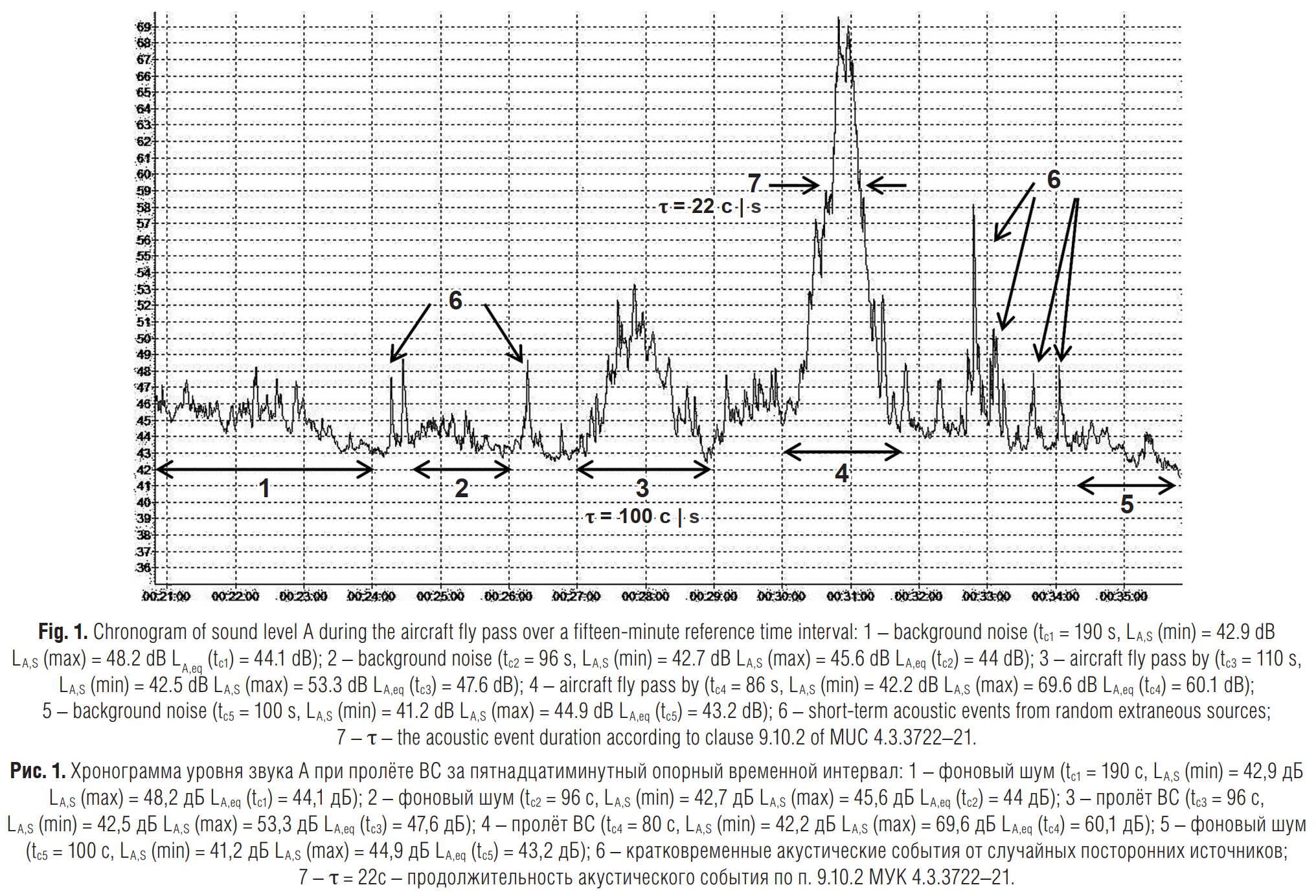
The minimum, maximum and equivalent A-weighted SPL of background noise in periods 1, 2 and 5 differ significantly (from 41.2 to 48.2 dBA) and can radically alter the definition of the acoustic event (period 3) as aircraft noise with a maximum level of 53.3 dBA.
It is obvious that a sound event should be defined as aircraft noise on the basis of A-weighted SPL recorded during the aircraft’s overflight, over the period between the moments immediately preceding the start of the increase and the end of the decrease in the sound level. According to the chronogram (see Fig. 1) for the aircraft overflight (event 3), these will be the periods ≈ 00:27:00 and ≈ 00:29:00 in real time. For 20-second intervals prior to the start of the rise in sound level for this event, the minimum, maximum, and equivalent levels are 42.6, 44.2, and 43.2 dBA, and after the end of the decline – 42.5, 44.7, and 43.5 dBA, respectively. For the aircraft overflight (event 4), the corresponding periods will be ≈ 00:30:00 and ≈ 00:31:30 local time. Respectively, the minimum, maximum and equivalent A-weighted SPL before the rise start in the A-weighted SPL for the corresponding event are 44.7, 48.4, and 46 dBA, and after the decrease end – 44.2, 48.5 and 45.6 dBA.
The corresponding A-weighted SPL’ s in the current example, prior to the rise and after the fall in A-weighted SPL, are relatively similar (a difference of no more than 0.5 dB). However, when comparing the two events, we observe differences of approximately 2 dB in the minimum sound level, approximately 4 dB in the maximum, and approximately 3 dB in the equivalent level. It can be stated with a reasonable degree of certainty that in both cases the background noise level remained almost unchanged during the period of aircraft noise, but differed for each event.
Figure 2 shows the chronograms of aircraft noise events at various background noise levels before the rise begins and after the decrease end in sound level recorded during the aircraft flight.
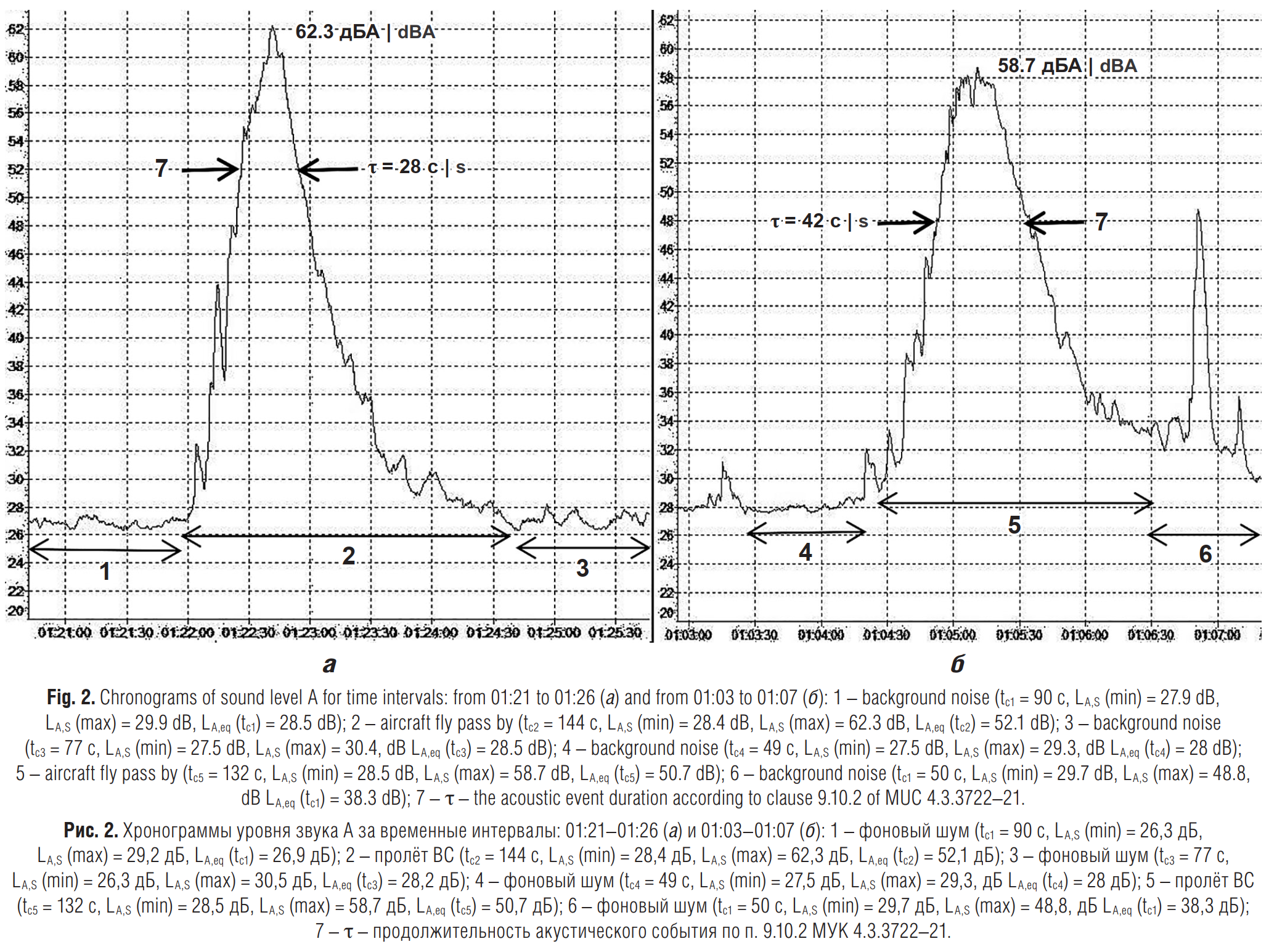
For time interval 1 prior to the rise in sound level of event 2 (aircraft overflight) the minimum, maximum, and equivalent background noise levels are 26.3; 29.2 and 26.9 dBA, and for time interval 3 after the decrease end – 26.3; 30.5 and 28.2 dBA respectively; so the difference between the corresponding sound levels before the rise start and after the decrease end is no more than 1.3 dB (see Fig. 2 a).
The minimum, maximum and equivalent background noise levels for time interval 4 (prior to the rise in A-weighted SPL associated with event 5, i.e. the aircraft overflight) are 27.5, 29.3, and 28 dBA, respectively, and for interval 6 (following the aircraft overflight) – 29.7, 48.8, and 38.3 dBA respectively (see Fig. 2, b). Even if the brief acoustic event at 01:06:52 is excluded from the analysis, the maximum and equivalent background noise levels will be 36.8 and 32.7 dBA, whilst the minimum level will remain unchanged.
The difference between the minimum A-weighted SPL’s prior to the rise and after the event 5 noise level has finished falling is 2.2 dB; the difference between the maximum and equivalent A-weighted SPL’s is more 6 dB; so, the background noise levels for intervals 4 and 6 are different significantly, particularly the maximum and equivalent A-weighted SPL’s (see Fig. 2, b).
Analysis of the measurement results shows that the values of the minimum A-weighted sound levels, measured immediately before the rise and after the end of the fall in sound level during the aircraft’s overflight, are the most stable and can be used to determine the A-weighted background noise level.
There are two possible methods for determining the background noise level: the first is as the average level measured during the periods immediately before the rise begins and after the decrease end in sound level; the second is based on their minimum value during a reference time interval exceeding the interval from the rise start to the falling end in noise level by 10–20 seconds.
The Methodological Guidelines MUK 4.3.3722–21, paragraph 9.10.2, establishes the following rule for determining the duration of aircraft noise: ‘…the duration of exposure is taken as the time during which the “upper” 10 dBA is present, i.e. the time during which the noise level is over the level equal the maximum measured level minus 10 dB.
In the example shown in Fig. 3, the superimposed chronogram graphs of two aircraft noise event models for the overflights of Aircraft 1 and Aircraft 2, with maximum A-weighted SPL’s of 42 and 66 dB respectively, against a background 30 dB A-weighted SPL.
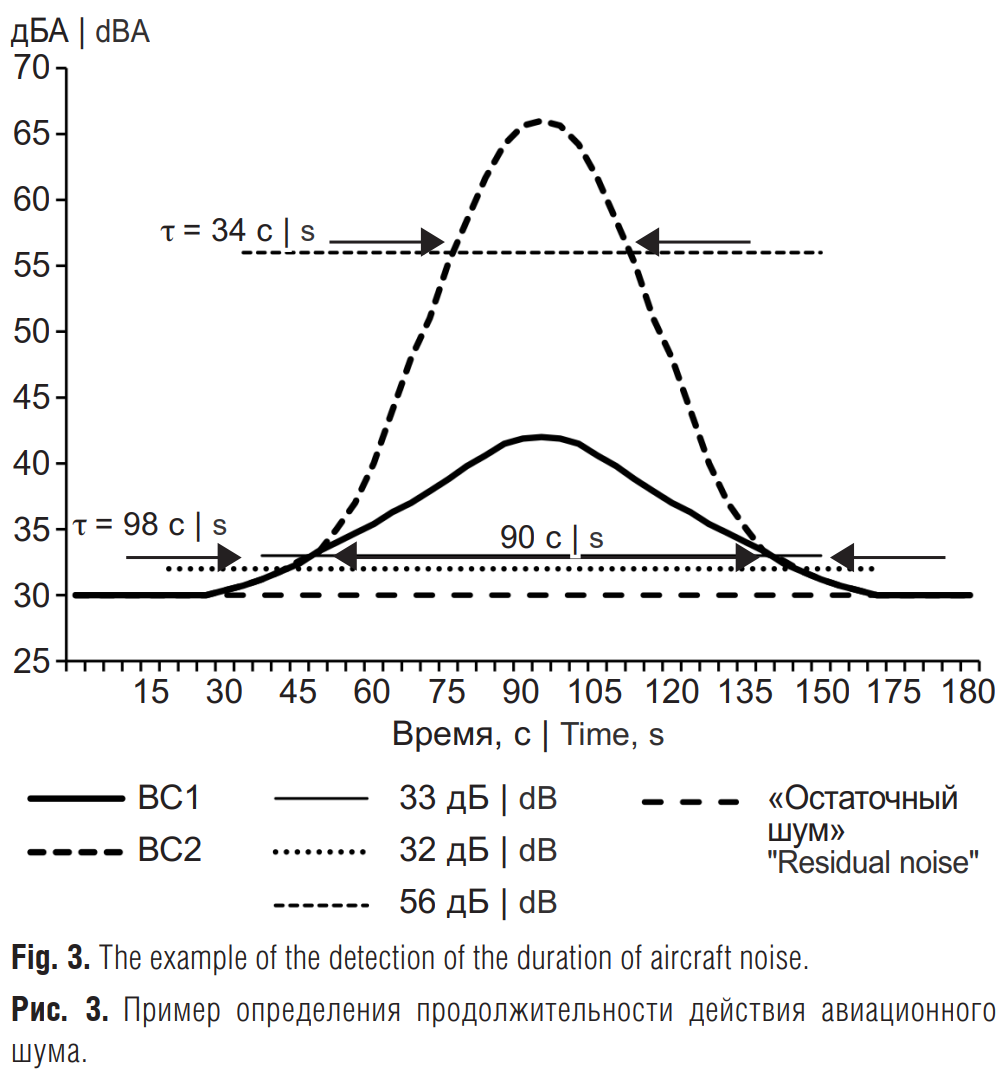
According to the Methodological Guidelines MUK 4.3.3722–21, paragraph 9.10.2, (i.e. at levels of 32 and 56 dB), the duration of aircraft noise for Aircraft 1 and Aircraft 2 is 98 and 34 seconds respectively. The total noise level (background and aircraft noise) will be equal 33 dBA at times when the aircraft noise level, as it rises and falls, equals the background noise level. The duration of total noise exceeding this value is 90 s. Thus, when following the Methodological Guidelines MUK 4.3.3722–21, paragraph 9.10.2, the duration of aircraft noise is overestimated if the maximum aircraft noise level slightly exceeds the background noise level. In cases where the noise level is significantly exceeded, however, the duration of aircraft noise is substantially underestimated.
This situation is confirmed by the example from measurement practice shown in Fig. 1. The duration of aircraft noise for events 3 and 4 under the Methodological Guidelines MUK 4.3.3722–21, paragraph 9.10.2, is 100 and 22 seconds, whilst the duration of these events, measured at the moments when the aircraft noise level, during its rise and fall, equals the background noise level, is 96 and 80 seconds, respectively.
The analysis of the examples given shows that, from the perspective of assessing the superposition of the functions describing changes in the sound levels of background noise (A) and aircraft noise (B), the method for measuring the duration of aircraft noise should be defined as the time interval between the moments when the level of the total noise, during its rise and fall, equals the background noise level plus 3 dB (according to the rule for summing levels in decibels). Such a method might work if the background noise level were stable during the measurement. Unfortunately, this is not always the case, as confirmed by the chronograms shown in Fig. 2.
In our view, to determine the background noise level and the duration of aircraft noise, it would be advisable to follow the following rules.
1. The A-weighted SPL of background noise during an aircraft overflight should be taken as the minimum A-weighted SPL measured with a ‘slow’ time correction over the reference time interval between the rise start in the total sound level and after the decrease end, extended by 10–20 seconds on either side.
2. The duration of aircraft noise should be measured between the moments when the A-weighted sound level of the total noise exceeds the background noise level by 6 dB.
An example of processing the A-weighted SPL chronogram during an aircraft overflight using the proposed algorithm is shown in Fig. 4.
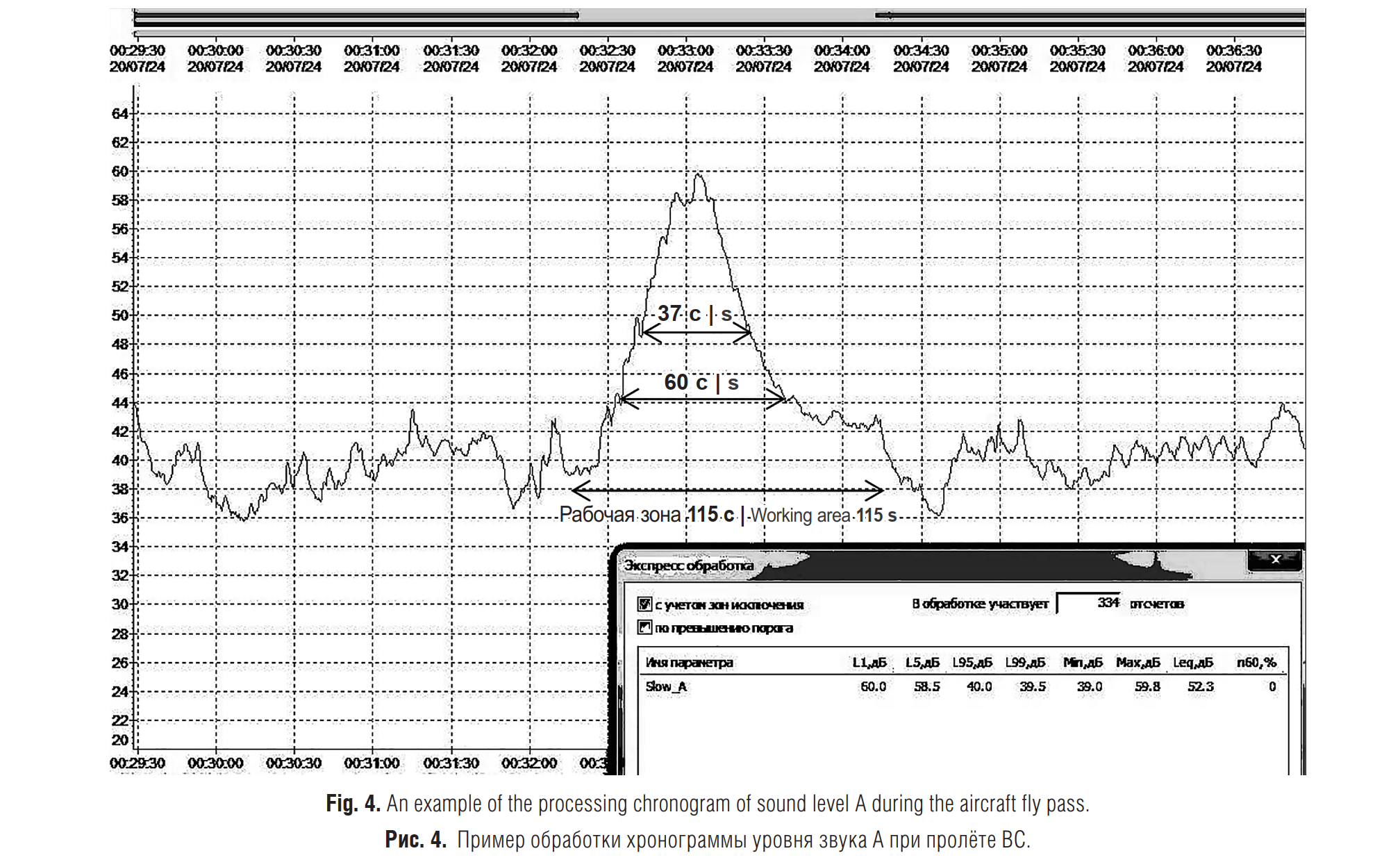
The timeline shown defines the operational zone for processing within the time interval from 00:32:20 to 00:34:15. The following A-weighted SPL measurements results were obtained during this time interval: L(AS)min = 39 dB, L(AS)max = 59.8 dB, L(A)eq = 52.3 dB. If we assume the background noise level during the aircraft overflight to be equal to L(AS)min, the duration of aircraft noise at a level of L(AS)min + 6 dB = 45 dB will be 60 s. The duration of this acoustic event, in accordance with Methodological Guidelines MUK 4.3.3722–21, paragraph 9.10.2, at a level of L(AS)max – 10 dB = 49.8 dB will be 37 s.
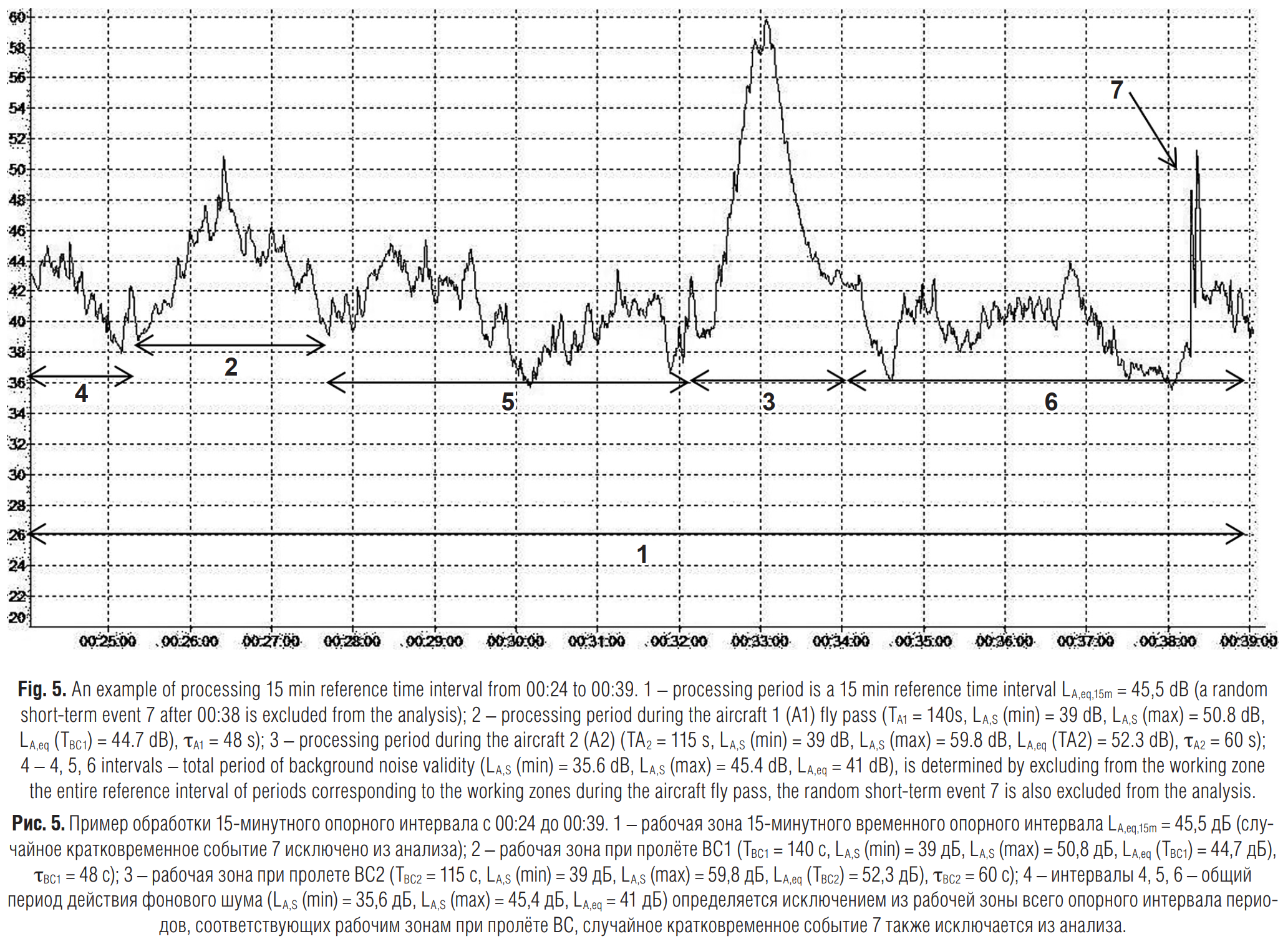
Figure 5 shows the chronogram of a 15-minute reference time interval from 00:24 to 00:39, during which two aircraft overflights were recorded at 00:26 (AC1) and 00:33 (AC2). The data was processed using the proposed algorithm. The duration of events τAC1 and τAC is defined at the 45 dB level.
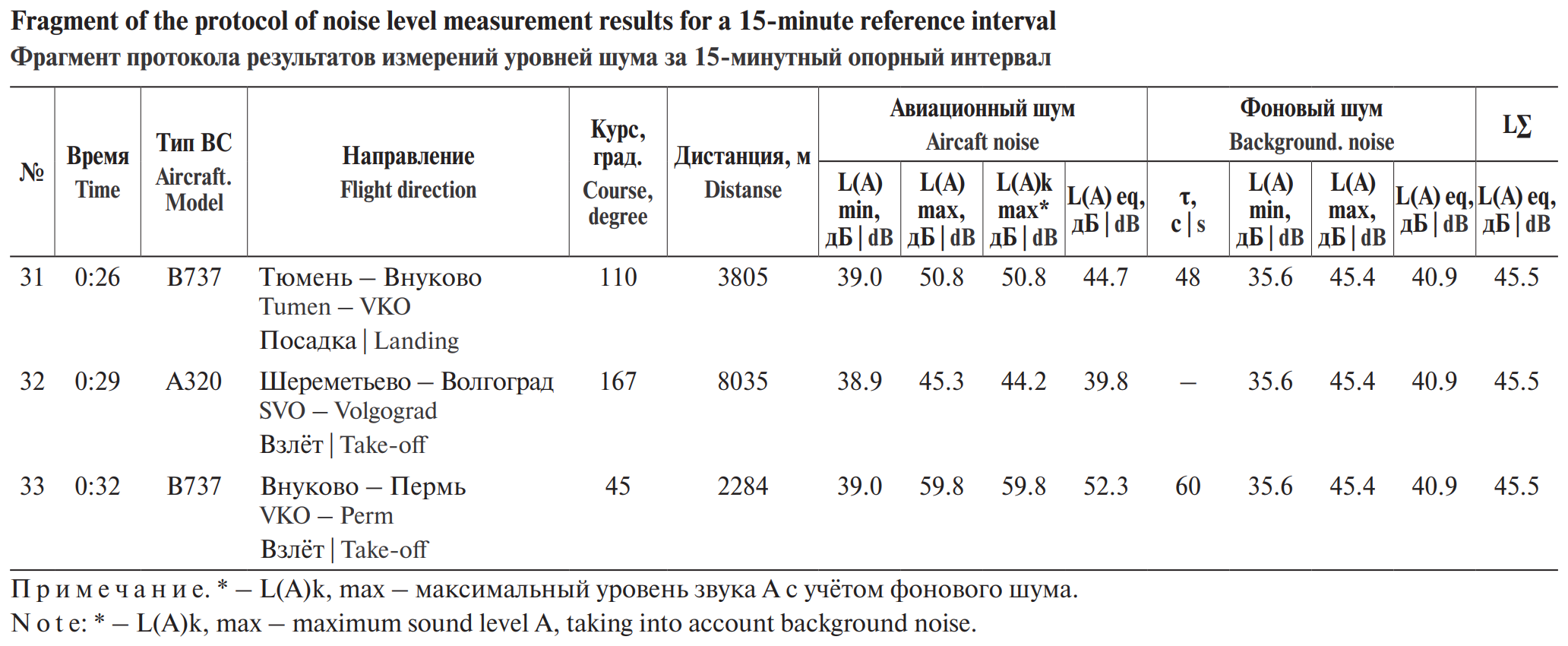
The table shows an excerpt from the measurement results log for the 15-minute reference time interval, the chronogram of which is shown in Fig. 5.
If necessary, the equivalent A-weighted SPL for the observation periods during the day and at night can be calculated by averaging the corresponding data for these same periods. The values of the standard uncertainty and expanded uncertainty are calculated in accordance with the equations (10) and (11) of the MUK 4.3.3722–21, Appendix 1. Similarly, the maximum A-weighted SPL’s for observation periods during the day and at night may be determined; their expanded uncertainty will be equal to the instrument error, as these are direct measurement data.
The assessment of the CCPs placement possibility is carried out using calculated ‘equivalent A-weighted sound levels’ determined for daytime and night-time hours over an average annual flight day (the MUK 4.3.3722–21, paragraph 9.10, the equation 6). The input data for this calculation are: the average values of the measured maximum A-weighted sound levels LA,max,avg for all recorded aircraft flights during both daytime and night-time (the MUK 4.3.3722–21, paragraph 9.10.1) and their expanded uncertainty at a 95% confidence level; the average effective noise exposure time τef,avg (the MUK 4.3.3722–21, paragraph 9.10.2); the number of noise exposures during the assessment period.
At the same time, the MUK 4.3.3722–21, paragraph 9.9 states: ‘When obtaining the equivalent sound level by calculation, a background correction to the results of direct measurements of the maximum sound level is applied, on the basis of which the equivalent level is calculated’.
It should be noted that the value calculated using the equation 6 in the Methodological Guidelines MUK 4.3.3722–21, paragraph 9.10 is not, by definition, an equivalent sound level. This indicator may be used as an estimate, but must be named differently, for example, “calculated estimated A-weighted SPL”.
The Methodological Guidelines MUK 4.3.3722–21, paragraph 9.10.2 proposes determining the duration τ of each event ‘…during the overflight of each aircraft and during ground operations of the aircraft…’. At the same time, τ is defined as ‘…the time during which the sound level exceeds the value 10 dB below the maximum measured value’, that is, not for all events during aircraft overflights, but only for acoustic events defined as ‘aircraft noise’. Furthermore, according to the Methodological Guidelines MUK 4.3.3722–21, it is proposed that the average effective exposure time τef,avg be determined for all recorded aircraft overflights or recorded ground operations. However, not all recorded events during aircraft overflights and ground operations can be defined as ‘aircraft noise’.
It is clear that when determining τ and calculating τef,avg, one should take into account data obtained for ‘aircraft noise’ events, rather than for all events during aircraft overflights or events related to ground operations.
An analysis of the ambiguous requirements of the Methodological Guidelines MUK 4.3.3722–21 and experience in conducting measurements and assessing noise levels allow the following recommendations to be made for determining the “calculated estimated A-weighted SPL”.
The aircraft noise average maximum A-weighted SPL, LАmax,avg, and their adjusted for background noise values, LАmaxk,avg, are virtually identical (a difference of 0.1–0.2 dB) when aircraft fly past at 1–1.5 km distances from the measurement point; the difference may be reach 1–2 dB if noise measure when aircraft flight paths at 3–4 km distances. At greater distances, events during aircraft flight can be classified as ‘aircraft noise’ only very rarely, for example at low (less than 30 dBA) background noise. The results of determining the ‘calculated estimated A-weighted SPL’ under otherwise identical conditions will also differ by a comparable amount. It is advisable to perform the calculation for both cases, and the contribution of background noise can be assessed based on the difference in results.
The value of the expanded uncertainty at a 95% confidence level is determined in accordance with the Methodological Guidelines MUK 4.3.3722–21, Appendix 1. The calculation results for the expanded uncertainty L(A)max and L(A)maxk are practically identical, which allows this indicator to be used for both cases of determining the ‘calculated estimated A-weighted SPL’.
Discussion
The hygienic assessment of noise compliance in residential areas with regulatory documents and the determination of the contribution of aircraft noise to the total noise level should be carried out using the following values:
In international practice, to assess the impact of aircraft noise on the population, in addition to these parameters, the SEL indicator is used, which determines the equivalent A-weighted SPL of a single sound event of arbitrary duration, normalized to a reference interval of 1 s [10]. However, studies have demonstrated a correlation between sleep disturbances and the subsequent development of hypertension with maximum A-weighted SPL measured in “slow” time correction [6, 7].
The justification for the possibility of placement of CCPs in the seventh subzone of the airport territory based on predicted A-weighted SPL’s for an average annual flight day or another period of time, for example, a day with the maximum number of take-off and landing operations (TLOs), is based on the use of an indicator, calculated from the maximum A-weighted sound levels of each acoustic event, and the effective duration of acoustic events associated with overflights, engine testing or aircraft taxiing, and the operation of the auxiliary power unit (APU) (the Methodological Guidelines MUK 4.3.3722–21, paragraph 9.2). This indicator is similar to calculation parameters used in the USA and Europe, such as DNL [10] and Lden [11].
Measurements must be taken over several reference time intervals during an extended observation period (4–24 hours), both for hygienic assessment and for determining the data required to estimate the predicted A-weighted equivalent SPL’s; it is advisable to determine these intervals based on A-weighted SPL chronograms measured using the ‘slow’ time correction.
It is advisable to divide MUK 4.3.3722–21 (under next revision) into two separated parts, in which to specify the lists of necessary noise parameters and requirements for conducting measurements depending on the objectives:
for the hygienic assessment of noise from all sources in the premises of residential and public buildings and in residential areas for compliance with the requirements of the Sanitary Rules and Norms SanPiN 1.2. 3685–21, the maximum and equivalent A-weighted SPL must be measured in reference time intervals (15 minutes) during representative observation periods during the day and night, or over a full 24-hour period;
to calculate the estimated A-weighted SPL for the purpose of determining the locating capital construction projects possibility in the seventh subzone of the airport vicinity, the maximum A-weighted SPL during aircraft overflights, the A-weighted background noise levels during aircraft overflights, and the duration of each aircraft noise event must be measured.
In both cases, it is advisable to apply an analysis of A-weighted sound level chronograms, which not only provides all the necessary data, but also excludes random acoustic events from the analysis, thereby improving the quality of the noise level assessment.
Conclusion
The technology for measuring regulated aviation noise parameters in residential areas has been developed for the first time, using direct measurements and A-weighted SPL chronograms, measured with a ‘slow’ time correction, for health-based assessment and for predicting the possibility of locating construction projects.
Key provisions of the technology. The background noise level during aircraft overflights should be taken as equal to the minimum A-weighted SPL, measured with a ‘slow’ time correction over a reference time interval from the rise start in the total sound level to the decrease end, extended by 10–20 seconds on each side.
The duration of ‘aircraft noise’ events is measured as the interval between the moments when the A-weighted sound level of the total noise exceeds the background noise level by 6 dB.
The duration of aircraft noise and the average effective duration τef,avg should be calculated using data obtained for ‘aircraft noise’ events, rather than for all events during aircraft overflights or events associated with ground operations.
¹ Sanitary Rules SP 2.1.8.3565–19 Specific sanitary and epidemiological requirements for the assessment of intermittent noise from aircraft overflights. URL: https://www.garant.ru/products/ipo/prime/doc/72822802/
² Sanitary Rules and Norms SanPiN 1.2.3685–21 ‘Hygienic standards and requirements for ensuring the safety and/or harmlessness to humans of environmental factors’. URL: http://publication.pravo.gov.ru/document/0001202504090006
³ Order of Rospotrebnadzor No. 664 of 7 December 2022 ‘On the Approval of the Methodology for Establishing the Seventh Subzone of the Airport Perimeter Area, and for Calculating and Assessing Health Risks’. URL: https://pravo.ppt.ru/prikaz/rospotrebnadzor/n-963-307034
⁴ Order of Rospotrebnadzor No. 150 of 28 February 2024 ‘On Amending Order of Rospotrebnadzor No. 664 of 7 December 2022’ ‘On the Approval of the Methodology for Establishing the Seventh Subzone of the Aerodrome Territory, and for Calculating and Assessing Risks to Human Health’. URL: http://publication.pravo.gov.ru/document/0001202402280010?ysclid=mha9w624ri723055289
⁵ Order of Rospotrebnadzor No. 963 of 5 December 2024 ‘On amending Order of Rospotrebnadzor No. 664 of 7 December 2022 “On the approval of the Methodology for establishing the seventh subzone of the aerodrome territory, and for calculating and assessing risks to human health”. URL: https://pravo.ppt.ru/prikaz/rospotrebnadzor/n-963-307034
⁶ Methodological guidelines MUK 4.3.3722–21 Control of noise levels in residential areas, residential and public buildings and premises. Approved by Rospotrebnadzor on 27 December 2021. URL: https://www.garant.ru/
⁷ GOST 23337–2014 Noise. Methods for measuring noise in residential areas and in the premises of residential and public buildings. URL: https://docs.cntd.ru/document/1200114242
⁸ GOST 22283–14 Aircraft noise. Permissible noise levels in residential areas and methods for their measurement. URL: https://docs.cntd.ru/document/1200112157
⁹ State Standard GOST R 53187–2008 Acoustics. Noise monitoring in urban areas. URL: https://docs.cntd.ru/document/1200069469
¹⁰ State Standard GOST 31296.1–2005 (ISO 1996–1:2003) Noise. Description, measurement and assessment of noise in the field. Part 1. Basic quantities and assessment procedures. URL: https://docs.cntd.ru/document/1200046350
¹¹ State Standard GOST 31296.2–2006 (ISO 1996–2:2007) Noise. Description, measurement and assessment of noise in the field. Part 2. Determination of sound pressure levels. URL: https://docs.cntd.ru/document/1200062369
1. Bukhtiyarov I.V., Courierov N.N., Lagutina A.V., Prokopenko L.V., Zibarev E.V. Aircraft noise in residential areas, problems of measuring and evaluation. Gigiena i Sanitaria (Hygiene and Sanitation, Russian journal). 2020; 99(10): 1042–8. https://doi.org/10.47470/0016-9900-2020-99-10-1042-1048 https://elibrary.ru/pgubsy
2. Burden of disease from environmental noise. Quantification of healthy life years lost in Europe. The WHO European Centre for Environment and Health, JRS European commission; 2011.
3. Peters J.L., Zevitas C.D., Redline S., Hastings A., Sizov N., Hart J.E., et al. Aviation noise and cardiovascular health in the United States: a review of the evidence and recommendations for research direction. Curr. Epidemiol. Rep. 2018; 5(2): 140–52. https://doi.org/10.1007/s40471-018-0151-2 https://elibrary.ru/smctds
4. Kroesen M., Schreckenberg D. A measurement model for general noise reaction in response to aircraft noise. J. Acoust. Soc. Am. 2011; 129(1): 200–10. https://doi.org/10.1121/1.3514542
5. Federal Aviation Administration. Aviation Noise. Available at: https://www.faa.gov/regulations_policies/policy_guidance/noise/
6. Babisch W., Houthuijs D., Pershagen G., Katsouyanni K., Velonakis M., Cadum E., et al. Association between noise annoyance and high blood pressure. In: Preliminary Results from the HYENA Study. Proceedings of Internoise Conference. Turkey; 2007.
7. Haralabidis A.S., Dimakopoulou K., Vigna-Taglianti F., Giampaolo M., Borgini A., Dudley M.L., et al. Acute effects of night-time noise exposure on blood pressure in populations living near airports. Eur. Heart J. 2008; 29(5): 658–64. https://doi.org/10.1093/eurheartj/ehn013
8. Babisch W. Noise and health. Environ. Health Perspect. 2005; 113(1): A14–5. https://doi.org/10.1289/ehp.113-a14
9. Washington Post. Analysis: Where noisy roads and airports take the biggest toll on our health and sanity; 2017.
10. e-CFR PART 150 – Airport noise compatibility planning. Available at: https://www.ecfr.gov/cgi-bin/textdx?SID=f8e6df268e3dad2edb848f61b9a0fb51&mc=true&node=pt14.3.150&rgn=div5#se14.3.150_11
11. Directive 2002/49/EC of the European Parliament and of the Council relating to the assessment and management of environmental noise – Declaration by the Commission in the Conciliation Committee on the Directive relating to the assessment and management of environmental noise; 2002.
DSc (Medicine), professor, academician of RAS, Honored Scientist of the Russian Federation, Director, Izmerov Research Institute of Occupation Health, Moscow, 105275, Russian Federation
e-mail: ivbukhtiyarov@mail.ru
DSc (Medicine), professor, chief researcher, Izmerov Research Institute of Occupation Health, Moscow, 105275, Russian Federation
e-mail: prokopenko@irioh.ru
PhD (Biology), leading researcher, Laboratory of physical factors, Izmerov Research Institute of Occupation Health, Moscow, 105275, Russian Federation
e-mail: courierov@mail.ru
PhD (Medicine), leading researcher, Laboratory of physical factors, Izmerov Research Institute of Occupation Health, Moscow, 105275, Russian Federation
e-mail: alagutina@inbox.ru
Junior researcher, Laboratory of physical factors, Izmerov Research Institute of Occupation Health, Moscow, 105275, Russian Federation
e-mail: vj.ilya@bk.ru
Bukhtiyarov I.V., Prokopenko L.V., Courierov N.N., Lagutina A.V., Dzhikiya I.Z. Aircraft noise measuring technology in residential areas using sound level chronograms. Hygiene and Sanitation. 2026;105(2):102-109. https://doi.org/10.47470/0016-9900-2026-105-2-102-109. EDN: lnlcpp
Мы в ВК:

 Email this article (Login required)
Email the author (Login required)
Email this article (Login required)
Email the author (Login required) 141014, The Moscow region, Mytishchi, 2, Semashko street
Federal Scientific Center of Hygiene named after F.F. Erisman
Phone: +7 916 885 28 02
e-mail: gigsan@list.ru