Contents
Scroll to:
https://doi.org/10.47470/0016-9900-2026-105-2-164-169
EDN: ixaont
Scroll to:
Introduction. The work of medical workers at PCR laboratories during the pandemic is classified as a high-risk occupational activity.
The purpose of the study. Comparative assessment of the working conditions in medical workers at PCR laboratories during both the COVID-19 pandemic and a normal epidemic situation.
Materials and methods. Measurement and assessment of factors at workplaces were carried out by generally accepted methods. Measurement and assessment of local vibration parameters were carried out by an analyzer of the 10 accuracy class ASSISTANT V3RT. Chronometric observation was carried out (7 person-shifts).
Results. Working conditions according to the biological factor are classified as harmful – third class, third degree (3.3). No differences in the microclimate and lighting parameters in PCR laboratories during the COVID-19 pandemic and during a normal epidemic situation were found. Local vibration parameters when working on the Vortex V3 shaker correspond to mid-frequency (75–200 Hz). Exceeding the maximum permissible level at octave frequencies from 8 Hz to 63 Hz were detected; the maximum excess was recorded along the Y axis of 11.5 dB, which corresponds to class 3 of the 4th degree of working conditions. The duration of exposure to local vibration during the pandemic period is 4–5 times longer than in a calm epidemic situation (the number of samples per work shift is more than 800 and 150–200, respectively). Differences in the assessment of the severity and intensity of work were revealed, which is also associated with the intensity of the load. During the pandemic, the number of small stereotypical movements per shift reached 41–45 thousand, which corresponds to class 3.1 of working conditions in terms of severity.
Limitations. Missing.
Conclusion. The revealed differences in the working conditions in medical workers at PCR laboratories during both the COVID-19 pandemic and a normal epidemic situation allow concluding that there is a higher risk of developing occupational diseases associated with functional overstrain of the joints of the fingers, wrist, and the muscular-ligamentous apparatus of the hand when exposed to local vibration during the COVID-19 pandemic.
Compliance with ethical standards. The study was approved by the local ethics committee of the Volgograd State Medical University (meeting minutes No. 2025/022, 03/28/2025), conducted in accordance with the generally accepted scientific principles of the Helsinki Declaration of the World Medical Association (2013 edition). All participants gave informed voluntary written consent to participate in the study.
Contribution:
Shkarin V.V. – study concept and design, editing;
Latyshevskaya N.I. – study concept and design, data processing, writing, editing;
Yatsyshena T.L. – study concept and design, data collection and data processing, writing, editing;
Orlov D.V. – data collection and data processing, writing.
All authors are responsible for the integrity of all parts of the manuscript and approval of the manuscript final version.
Conflict of interest. The authors declare no conflict of interest.
Funding. The study had no sponsorship.
Received: April 8, 2025 / Accepted: October 15, 2025 / Published: March 13, 2026
Shkarin V.V., Latyshevskaya N.I., Yatsyshena T.L., Orlov D.V. Working conditions in medical workers of the PCR laboratories in various epidemiological situations. Hygiene and Sanitation. 2026;105(2):164-169. https://doi.org/10.47470/0016-9900-2026-105-2-164-169. EDN: ixaont
Introduction
Laboratory diagnostics provide the majority of information in contemporary medicine. According to the WHO data, laboratory tests account for 75–90% of various types of diagnostics, and over 70% of medical decisions are made on the basis of laboratory data [1,2]. According to the estimates by Business Stat, in 2023 the laboratory diagnostics market in Russia amounted to 413.2 million tests. Compared with the 2021 level (482.7 million tests), the figure fell by 14%. The main reason was a decline in the number of tests for COVID-19. However, the decline was mitigated by steady demand for ‘traditional’ tests: clinical blood tests and the ‘hospital quartet’ (detection of antibodies to HIV, hepatitis B and C, and syphilis) [3]. Consequently, the number of operational PCR laboratories has changed (decreased), and the nature and working conditions of specialists may have changed.
Domestic hygiene publications address occupational health issues in modern clinical diagnostic laboratories [4–7], yet comprehensive studies of working conditions and health risk factors for PCR laboratory staff are virtually non-existent. The most comprehensive findings relate to the thermal status of healthcare workers in these units, driven by the mandatory use of personal protective equipment (PPE) during the COVID-19 pandemic and its impact on heat exchange [8–11]. A comparative assessment of the working conditions of PCR laboratory staff during the COVID-19 pandemic and in non-pandemic times is of interest.
The aim of the study was to conduct a comparative assessment of the working conditions of healthcare workers in PCR laboratories during the COVID-19 pandemic and during a routine epidemic situation, in order to provide a physiological and hygienic justification for the duration of the working shift, the actual workload and the labour costs of staff when performing PCR testing.
Materials and methods
The study was carried out at the PCR laboratory of the State Budgetary Healthcare Institution ‘City Children’s Clinic No. 2’ in Volzhsky (1); the PCR laboratory of the Federal Budgetary Institution of Public Health ‘Centre for Hygiene and Epidemiology in the Volgograd Region’ (2), and the immunological laboratory of the State Budgetary Healthcare Institution ‘Volgograd Regional Centre for the Prevention and Control of AIDS and Infectious Diseases’ (3).
The measurement and assessment of physical factors in the workplace were carried out using standard methods and calibrated equipment for occupational health and safety studies. The microclimate parameters in the production areas of PCR laboratories were studied: temperature, relative humidity, and air velocity (measured using a Testo 400 instrument). A TKA-PKM-24 thermohygrometer was used to calculate the thermal stress index (TSI) of the air environment in accordance with the requirements of the Methodical Guidelines MUK 4.3.2756–10¹. Lighting environment parameters were measured using the ‘Ecolight-01’ luxmeter-luminance meter-pulsometer; sound levels were measured using the OKTAVA-110A-B3 sound level meter and spectrum analyser. Measurements and assessment of local vibration parameters complied with the requirements of GOST 31192.1–2004² and GOST 31192.2–2005³. An ASSISTANT V3RT analyser of accuracy class 10 was used. Further evaluation of all data obtained was carried out in accordance with SanPiN 1.2.3685–21⁴ and the ‘R 2.2.2006–05’ Guidelines⁵.
To assess the severity and intensity of work for PCR laboratory staff, time (chronometric) and-motion studies were carried out (a total of 7 person-shifts). All data obtained were processed using a variational-statistical method with the calculation of mean values (M) and representativeness errors (± m); the significance of differences was determined using Student’s t-test. The study was conducted in strict compliance with the ethical standards set out in the 1975 Declaration of Helsinki, as amended in 2008. Medical staff at the PCR laboratories completed the ‘Informed Voluntary Consent to Participate in the Study’ form, developed in accordance with the requirements of the local ethics committee of Volgograd State Medical University.
Results
The professional functions of a medical laboratory technician and a paramedic-laboratory technician in PCR laboratories involved working in the ‘dirty’ zone of the workstations (preparing reagents, preparing samples for amplification and loading samples into the amplifier) and in the ‘clean’ zone at the computer (interpreting amplification results using the amplifier’s software module, and handling documentation and reports). These tasks were carried out by the same employee, moving from one zone to the other. One of the key occupational factors affecting these specialists’ working conditions is biological, as their work involves potential contact with microorganisms of pathogenicity group II. During the pandemic, this primarily refers to the SARS-CoV-2 virus. According to the results of a special working conditions assessment (SWCA), PCR laboratories are classified as Class 3, Grade 3 hazardous due to biological factors (based on the potential risk of infection with highly contagious pathogens).
The identification of working conditions based on physical factors at the workstations of laboratory doctors and laboratory paramedics in PCR laboratories revealed that microclimate, lighting and local vibration parameters require further study and assessment. Microclimate parameters in the PCR laboratory premises were maintained by water heating during the cold season and by air conditioning during the warm season. The results obtained did not differ significantly across the base (1, 2, 3) laboratories. Average parameters in the ‘clean’ zone: air temperature +22.34 ± 1.82°C, relative humidity 58.72 ± 3.66%, air velocity 0.2 ± 0.02 m/s. Average parameters in the ‘contaminated’ zone: air temperature +22.6 ± 2.23°C, relative humidity 62.32 ± 4.54%, air velocity 0.2 ± 0.02 m/s. The indicators complied with permissible working conditions (class 2).
A comparative assessment of lighting at the main workstations in PCR laboratories was carried out as a professionally significant factor. All rooms had natural and artificial lighting. As a rule, this was a combination of both, which provided specialists with optimal visibility conditions when carrying out laboratory tests and procedures. Time-recording data showed that the relative duration of visual work whilst looking at the work surface was at least 70%.
The work surface was horizontal, with the plane 0.8–1 m above the floor. Taking these characteristics into account, the standardized parameters of Sanitary Norms and Rules SanPiN 1.2.3685–21 and the actual lighting parameters are presented in Table 1.
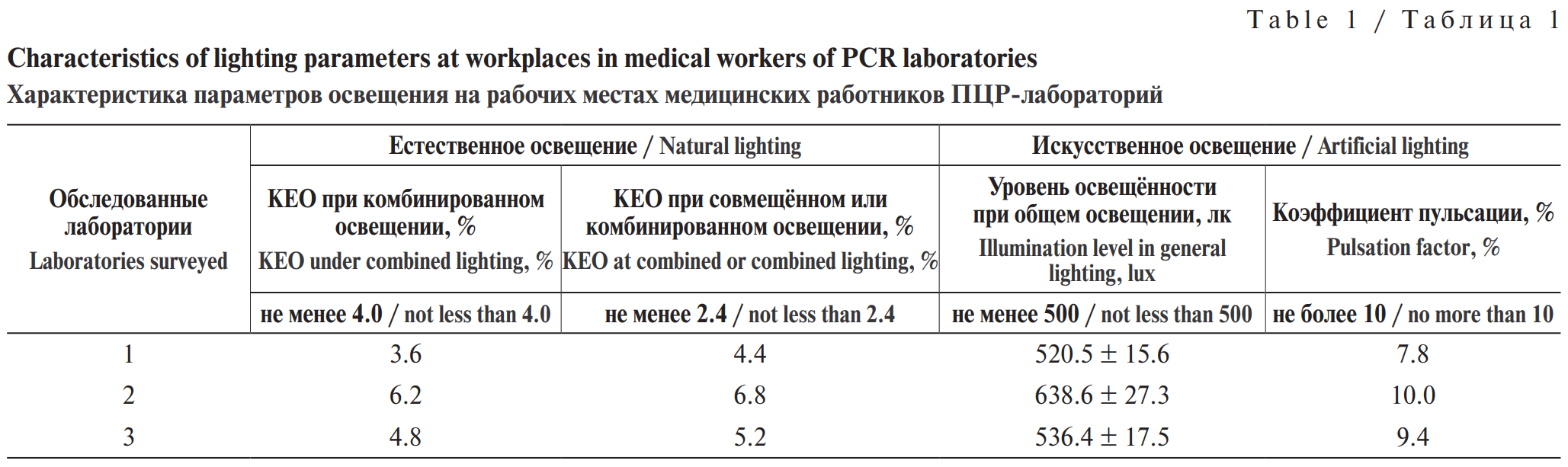
Artificial lighting of the workstations was provided by combined and integrated lighting created by fluorescent and LED lamps. At all workstations, the parameters of natural and artificial lighting complied with health and safety requirements. The analysis of lighting uniformity showed that it was uniform in all laboratory rooms. Thus, the illuminance levels at workstations can be classified as belonging to the second permissible class of working conditions in accordance with the requirements of R 2.2.2006–05.
No differences were identified in the organisation of lighting in the main rooms of PCR laboratories during the COVID-19 pandemic compared to a typical epidemic situation.
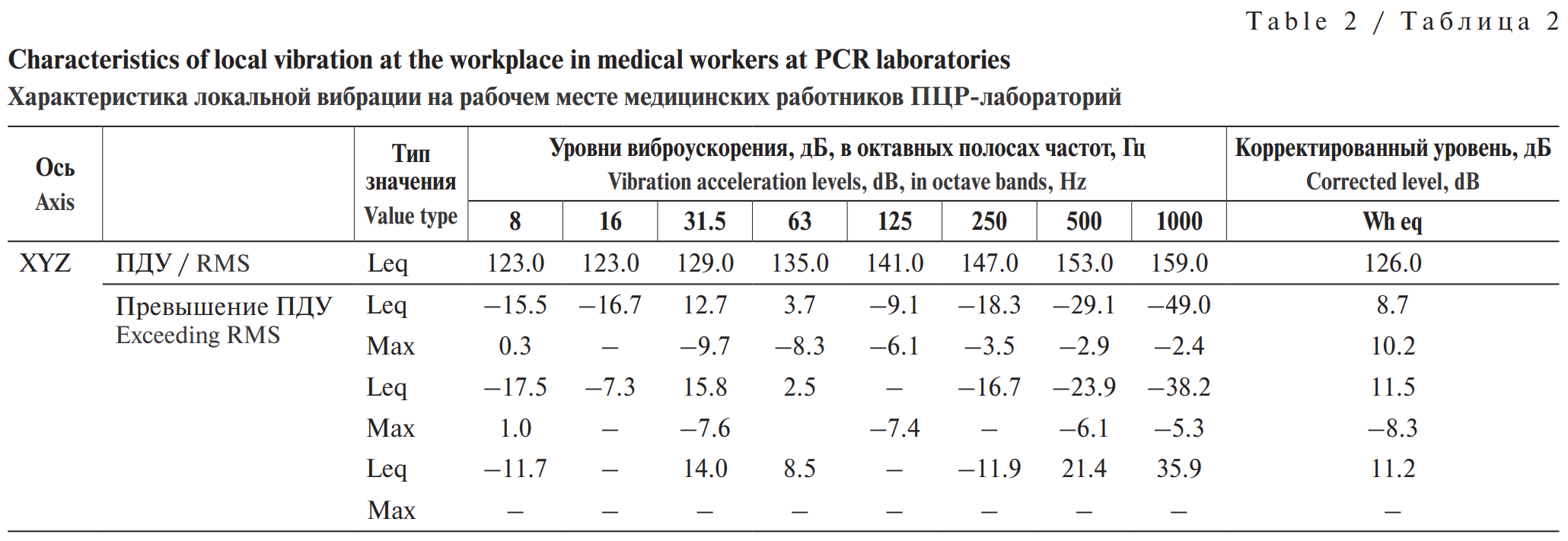
Particular attention was paid to the factor of vibration when assessing the working conditions of PCR laboratory staff. It was found that during the first stage of each analysis, PCR laboratory staff must place each Eppendorf-type tube containing biomaterial and added reagents onto the platform of a Vortex-type shaker and hold it there for (approximately) ≈ 10 seconds. Similar actions are repeated in the second stage when working with Eppendorf-type mini-tubes. Overall, during a shift, an employee is exposed to intermittent local vibration for between 1.5 and 2.5 hours. Local vibration parameters were measured (Table 2) whilst working on a Vortex V3 shaker with a conical universal adapter during the first, second and third stages of the PCR reaction. The rotational speed of the shaker platform and the Eppendorf tube held on it was within the range of 75–200 Hz, which corresponds to medium-frequency vibration. It is known that exposure to medium-frequency local vibration poses the greatest risk of adverse health effects on workers [12, 13]. This study found that the level of local vibration exposure exceeded the permissible exposure limit (PEL) at octave frequencies ranging from 8 to 63 Hz. The greatest deviations from occupational health standards were recorded along the Y-axis, which is perpendicular to the worker’s palm, and the Z-axis, which is parallel to the forearm. The maximum exceedance was recorded along the Y-axis (11.5 dB), which corresponds to Class 3, Grade 4 working conditions.
Chronometric observation made it possible to assess the labour conditions of PCR laboratory staff in terms of the severity and intensity of the work process. It was found that carrying out PCR testing involves a large number of minor manual tasks: at each stage, it is necessary to take a test tube, open its cap, open the reagent vial, draw the reagent into the pipette, close the reagent vial, dispense the reagent into the test tube and close its cap, move the test tube a distance of 2–3 m, place it on the conical adapter of a Vortex-type shaker (Vortex), hold it in place whilst switching it on, and later switch it off. Subsequently, take the test tube, return it to the laminar flow hood and place it on a special tray for loading into the amplifier. Thus, working with just one test tube at each stage involves 12–14 repetitive actions. As during the pandemic, a laboratory assistant or doctor analyzed between 350 and 800 samples, the number of small, repetitive movements per shift ranged from 8,000 to 22,000 in the first stage. Similar actions are performed in the second stage of the diagnostic procedure and, to some extent, in the third stage. Overall, the number of small repetitive movements per shift reached 41,000–45,000, which corresponds to working conditions class 3.1 by severity During periods of a calm epidemic situation, the number of samples drops sharply, not exceeding 180–200 per shift, which allows the severity of work for PCR laboratory staff to be classified as acceptable (Class 2) according to this criterion. The working posture of medical staff whilst performing their main professional duties is characterized as uncomfortable, as certain operations are performed with the torso bent or twisted, and with arms raised above shoulder level (Order of the Russian Ministry of Labour No. 817n of 21 November 2023)⁶. According to time-recording data, during the pandemic period these actions account for more than 50% of the working shift (working conditions class 3.1), whilst during a calm epidemic situation: no more than 25% (working conditions class 2). An assessment of the indicators of work intensity for PCR laboratory staff has enabled their work to be classified as harmful of the first degree in accordance with the requirements of Guideline R 2.2.2006–05: six indicators are rated as class 3.1, whilst the remaining indicators fall into classes 1 and/or 2. During non-pandemic periods, the labour of medical staff in PCR laboratories is classified as acceptable due to a reduction in two indicators (time spent looking at video screens and working under time pressure).
Discussion
The issue of COVID-19 is of particular relevance to healthcare workers (doctors, nurses and junior staff), as well as non-medical staff who come into contact with patients [14]. This applies in full to doctors and laboratory technicians in PCR laboratories. In terms of the risk of contracting coronavirus infection, the work of staff in these departments is classified as high-risk [15–17]. The work of medical staff in PCR laboratories during the pandemic has specific characteristics linked to the epidemiological situation. Thus, the high intensity of work, accompanied by a significant increase in the number of laboratory samples, may lead to working conditions that do not meet hygiene requirements.
As this study has shown, in PCR laboratories, intermittent local vibration is one of the leading and determining factors for potential risks to workers’ health, alongside biological factors. The effect of local vibration exposure depends on its level and the duration of exposure.
During the pandemic, the duration of exposure to a source of medium frequency intermittent local vibration reached 2.5 hours. Prolonged exposure to low- and medium-frequency vibration primarily leads to the development of angiodystonic syndrome and musculoskeletal disorders [18]. Early signs of upper limb damage include vascular disorders, reduced hand muscle strength, and changes in tendon structure. In the present study, we observed the effects of local vibration in combination with physical overload caused by a large number of repetitive movements involving the muscles of the hands and fingers whilst holding small objects (Eppendorf-type tubes and mini-tubes of this type), which, according to a number of authors, may exacerbate the effects of vibration [19, 20].
A comparative assessment has revealed differences in the working conditions of PCR laboratory staff in terms of the severity and intensity of the work process during the COVID-19 pandemic (class 3.1) and during periods of low epidemic activity (class 2). This is explained by a 4–5-fold increase in the number of tests performed and, consequently, greater work intensity. The large number of PCR tests per shift during the COVID-19 pandemic may be a cause of nucleic acid contamination in laboratories, which also poses a risk of false-positive results and necessitates the suspension of laboratory testing, whilst decontamination measures are carried out and their effectiveness is monitored [21, 22]. All this increases the time staff spend in uncomfortable working positions (cleaning and disinfecting rooms and laminators). The differences identified by this study in the assessment of working conditions for healthcare workers in PCR laboratories during the COVID19 pandemic and during a routine epidemic situation confirm the authors’ view that the scaling up of testing volumes during the pandemic is limited by the technological, material and human capacities of existing laboratories [23].
Conclusion
The identified differences in the working conditions of healthcare workers in PCR laboratories during the COVID-19 pandemic and during a routine epidemic situation suggest a higher risk of developing occupational diseases associated with functional overuse of the finger joints, wrists and the musculotendinous apparatus of the hand when working with intermittent local vibration during the COVID-19 pandemic. A physiological and hygienic justification is required for the duration of healthcare workers’ shifts, taking into account the actual workload and labour costs of laboratory staff when carrying out PCR testing. Further research is also required into the optimization of the workplace for PCR laboratory specialists, as ergonomic, engineering and technical, and vibration-damping interventions can be highly effective in reducing occupational risks arising from the nature and conditions of work.
¹ MUK 4.3.2756–10 Guidelines for the measurement and assessment of the microclimate in industrial premises.
² State Standard GOST 31192.1–2004 (ISO 5349–1:2001) Measurement of local vibration and assessment of its effects on humans. Part 1.
³ State Standard GOST 31192.2–2005 (ISO 5349–2:2001) Measurement of local vibration and assessment of its effects on humans. Part 2.
⁴ Sanitary Rules and Norms SanPiN 1.2.3685–21 ‘Hygienic standards and requirements for ensuring the safety and (or) harmlessness to humans of environmental factors’.
⁵ R 2.2.2006–05 Occupational hygiene. Guidance on the hygienic assessment of factors in the working environment and work processes. Criteria and classifications of working conditions.
⁶ Order No. 817n of 21 November 2023 ‘On the approval of the methodology for conducting a special assessment of working conditions, the classification of harmful and/or hazardous occupational factors, the form of the report on the special assessment of working conditions, and instructions for completing it’.
1. Vazhenina A.A., Trankovskaya L.V., Anishchenko E.B. Hygienic assessment of working conditions of employees in the test laboratory center of the office of federal service for supervision of consumer rights protection and human well-being. Gigiena i Sanitaria (Hygiene and Sanitation, Russian journal). 2019; 98(4): 418–23. https://elibrary.ru/boqhnc (in Russian)
2. Sveshchinskiy M.L., Kokareva Т.S., Plyusnina S.V., Chernykh S.V. Analysis of the use of laboratory tests in primary care in the Russian region. Laboratory Service. 2017; 6(3): 206–13. https://doi.org/10.17116/labs201763206-213 (in Russian)
3. Zolotaryov P.N., Cherkasov S.N. Medical laboratory services market in Russia. Bulletin of Semashko National Research Institute of Public Health. 2018; (4): 14–8. (in Russian)
4. Zolotarev P.N., Baeva E.S., Krasota O.V. Evaluation of the nature of labor of clinical and diagnostical laboratories employees. Meditsinskii al’manakh. 2015; (3): 15–8. https://elibrary.ru/unckdv (in Russian)
5. Nenakhov I.G., Stepkin Yu.I., Mekhanteva L.E. Complex evaluation of conditions of labor process of employees of test laboratory centers. Gigiena i Sanitaria (Hygiene and Sanitation, Russian journal). 2018; 97(8): 721–8. https://elibrary.ru/pawnpj (in Russian)
6. Balavneva A.A., Bakal’skaya E.V. The role of automation in improving the efficiency of work in clinical diagnostic laboratories. Alleya nauki. 2022; 1(8): 154–7. https://elibrary.ru/kmlrin (in Russian)
7. Alinejhad M., Aghlmand S., Feizollahzadeh S., Yusefzadeh H. The economic efficiency of clinical laboratories in public hospitals: A case study in Iran. J. Clin. Lab. Anal. 2020; 34(2): e23067. https://doi.org/10.1002/jcla.23067
8. Bukhtiyarov I.V., Kovalevsky E.V., Tskhomaria I.M. Evaluation of the effectiveness of personal protective equipment and their impact on the health of medical workers. Meditsina truda i promyshlennaya ehkologiya. 2023; 63(12): 817–24. https://doi.org/10.31089/1026-9428-2023-63-12-817-825 https://elibrary.ru/orwlir (in Russian)
9. Bukhtiyarov I.V., Geregey A.M., Krasnova S.V., Konyukhov A.V., Sazhina M.V., Malakhova I.S., et al. The thermal state of body when using personal protective equipment against biological factors. Gigiena i Sanitaria (Hygiene and Sanitation, Russian journal). 2022; 101(11): 1321–7. https://doi.org/10.47470/0016-9900-2022-101-11-1321-1327 https://elibrary.ru/nvvqpu (in Russian)
10. Shkarin V.V., Latyshevskaya N.I., Orlov D.V., Filatov B.N., Zhukova T.V., Belyaeva A.V. Hygienic assessment of risks of thermal balance disruption in medical laboratory workers using personal protective equipment for biohazards. Zdorov’e naseleniya i sreda obitaniya – ZNiSO. 2021; 29(11): 31–6. https://doi.org/10.35627/2219-5238/2021-29-11-31-36 https://elibrary.ru/kaijyy (in Russian)
11. Konyukhov A.V., Geregei A.M., Lemeshko V.I. Features of the thermal state of medical workers when using personal protective equipment against biological factors. Meditsina truda i promyshlennaya ehkologiya. 2020; 60(11): 801–3. https://doi.org/10.31089/1026-9428-2020-60-11-801-803 https://elibrary.ru/zunnci (in Russian)
12. Zhukova E.V., Kurenkova G.V. Vibration in the Workplace: Hygienic Characteristics, Standardization, Assessment, Prevention [Vibratsiya na rabochikh mestakh: gigienicheskaya kharakteristika, normirovanie, otsenka, profilaktika]. Irkutsk; 2023. https://elibrary.ru/zxwsoy (in Russian)
13. Bovenzi M., Prodi A., Mauro M. Relationships of neurosensory disorders and reduced work ability to alternative frequency weightings of hand-transmitted vibration. Scand. J. Work Environ. Health. 2015; 41(3): 247–58. https://doi.org/10.5271/sjweh.3490
14. Bukhtiyarov I.V., Gorblyanskii Yu.Yu. New coronavirus infection COVID-19: professional aspects of preserving the health and safety of medical workers: guidelines. Moscow; 2021. https://elibrary.ru/bvzbhq (in Russian)
15. Belova E.V., Mitrokhin O.V. Ranking of professions by risk of contracting coronavirus infection. In: Hygienic and Organizational Aspects of Countering the New Coronavirus Infection COVID-19 [Gigienicheskie i organizatsionnye aspekty protivodeistviya novoi koronovirusnoi infektsii COVID-19]. Moscow: Advanced solutions; 2022: 264–53. https://elibrary.ru/zgydrr (in Russian)
16. Coelho A.C., García Díez J. Biological risks and laboratory-acquired infections: a reality that cannot be ignored in health biotechnology. Front. Bioeng. Biotechnol. 2015; 3: 56. https://doi.org/10.3389/fbioe.2015.00056
17. Belova E.V., Zabroda N.N., Istratov P.A., Sidorova E.A., Simanovskiy A.A., Nesterov G.V., et al. Determining the risk level of COVID-19 infection of medical workers. Gigiena i Sanitaria (Hygiene and Sanitation, Russian journal). 2024; 103(10): 1176–82. https://doi.org/10.47470/0016-9900-2024-103-10-1176-1182 https://elibrary.ru/iizaip (in Russian)
18. Ivashova Ju.A., Polevaya E.A., Ponomareva T.A. Early signs of upper limb lesions in workers exposed to local vibration. Meditsina truda i promyshlennaya ehkologiya. 2019; 59(11): 960–5. https://doi.org/10.31089/1026-9428-2019-59-11-960-965 https://elibrary.ru/ekgfcn (in Russian)
19. Kochetova O.A., Kuprina N.I., Mal’kova N.Yu., Shilov V.V. Occupational polyneuropathy of upper limbs – contemporary approach to diagnosis, treatment and prevention. Meditsina truda i promyshlennaya ehkologiya. 2018; 58(3): 6–9. https://elibrary.ru/ytgheq (in Russian)
20. Poroshina M.M., Vlasova E.M., Perevalov A.Ya. Optimization of diagnostic system of hand diseases in employees working under combined effects of vibration and physical overloads. Meditsina truda i promyshlennaya ehkologiya. 2019; 59(11): 950–5. https://doi.org/10.31089/1026-9428-2019-59-11-950-955 https://elibrary.ru/lbtmys (in Russian)
21. Volynkina A.S., Ryazanova A.G., Rusanova D.V., Kulichenko A.N. The problem of DNA/RNA contamination in the laboratory during PCR testing for COVID-19. Zdorov’e naseleniya i sreda obitaniya – ZNiSO. 2021; 29(7): 76–81. https://doi.org/10.35627/2219-5238/2021-29-7-76-81 https://elibrary.ru/njwspe (in Russian)
22. Lippi G., Simundic A.M., Plebani M. Potential preanalytical and analytical vulnerabilities in the laboratory diagnosis of coronavirus disease 2019 (COVID-19). Clin. Chem. Lab. Med. 2020; 58(7): 1070–6. https://doi.org/10.1515/cclm-2020-0285
23. Ivoylov O.O., Kochetov A.G., Mininkova A.I. Medical laboratory staff labor cost analysis and modeling for Sars-CoV-2 RNA PCR-testing: a time-and-motion study. Rossiiskii meditsinskii zhurnal. 2022; 28(2): 103–17. https://doi.org/10.17816/medjrf108935 https://elibrary.ru/dobvxw (in Russian)
DSc (Medicine), professor, head, Department of Public Health and Healthcare, Institute of Continuous Medical and Pharmaceutical Education, Volgograd State Medical University, Volgograd, 400131, Russian Federation
e-mail: fuv-ozz@yandex.ru
DSc (Medicine), professor, head, Department of the general hygiene and ecology, Institute of Public Health named after N.P. Grigorenko,Volgograd State Medical University, Volgograd, 400131, Russian Federation
e-mail: latyshnata@mail.ru
PhD (Medicine), associate professor, Department of the general hygiene and ecology, Institute of Public Health named after N.P. Grigorenko, Volgograd State Medical University, Volgograd, 400131, Russian Federation
e-mail: tatyat@mail.ru
Assistant, Department of Public Health and Healthcare, Institute of Continuous Medical and Pharmaceutical Education, Volgograd State Medical University, Volgograd, 400131, Russian Federation
e-mail: platmed@yandex.ru
Shkarin V.V., Latyshevskaya N.I., Yatsyshena T.L., Orlov D.V. Working conditions in medical workers of the PCR laboratories in various epidemiological situations. Hygiene and Sanitation. 2026;105(2):164-169. https://doi.org/10.47470/0016-9900-2026-105-2-164-169. EDN: ixaont
Мы в ВК:

 Email this article (Login required)
Email the author (Login required)
Email this article (Login required)
Email the author (Login required) 141014, The Moscow region, Mytishchi, 2, Semashko street
Federal Scientific Center of Hygiene named after F.F. Erisman
Phone: +7 916 885 28 02
e-mail: gigsan@list.ru