Contents
Scroll to:
https://doi.org/10.47470/0016-9900-2026-105-5-553-559
EDN: bznzyi
Scroll to:
Introduction. Taking into account key activities of federal project «Health for Everyone», preservation of children’s health is of particular importance.
Aim is to assess the state of actual nutrition in school-age children living in territory of small indigenous peoples of Siberia.
Materials and methods. The study was conducted among children living in Okinsky district of Republic of Buryatia. Assessment of actual nutrition was carried out by questionnaire, processing of results using software. Statistical significance was assumed at p < 0.05.
Results. Assessment of optimality of proportion of macronutrients in structure of energy value in children’s diets showed that proportion of protein corresponds to norm, with exception of diets in 11–14 years girls with a low body mass index (BMI). There is a deficiency in the share of carbohydrates in the Energy Value (EV) with a surplus in the share of fats, saturated fatty acids, omega-6 polyunsaturated fatty acids (PUFA) and added sugar. In the lipid profile of children’s diets, the optimal proportion of PUFAs in EV is noted with an imbalance in the ratio of ≥ 3 and ≥ 6 PUFAs.
Limitations. Since information was obtained during a one-time examination, this does not allow to unambiguously prove causality of causes of overweight and obesity, most of which are multifactorial in nature.
Conclusion. The identified features of actual nutrition in children require coordinated work of an interdisciplinary team of experts to find an adequate solution in formation of optimal nutrition.
Compliance with ethical standards. The study complied with the World Medical Association’s Declaration of Helsinki (current version). Prior to conducting the study, approval was obtained from the Bioethics Committee of the East-Siberian Institute of Medical and Ecological Research (Protocol No. 2 dated June 11, 2024).
Contribution:
Bogdanova O.G. – concept and design of the study, collection of material, analysis and interpretation of data, writing and editing of the text;
Urbanova E.Z. – organization of the study, collecting material, statistical data processing, writing the primary version of the text;
Mylnikova I.V. – study design, text editing;
Mokhosoeva A.A. – collecting material, statistical data processing.
All co-authors – approval of the final version of the article, responsibility for the integrity of all parts of the article.
Acknowledgments. The authors express their gratitude: for the opportunity to conduct the study, the director of the Orlik Secondary School B.D. Sharastepanov, the teaching staff of the school and all participants in the study.
Conflict of interest. The authors declare no conflict of interest.
Funding. The study was carried out at the expense of a grant from the Russian Science Foundation No. 25-25-00092, https://rscf.ru/project/25-25-00092/
Received: July 7, 2025/ Revised: March 11, 2026 / Accepted: March 24, 2026 / Published: June 18, 2026
Bogdanova O.G., Urbanova E.Z., Mylnikova I.V., Mokhosoeva A.A. Characteristics of actual nutrition and its specificity in the child population, taking into account the territory of residence. Hygiene and Sanitation. 2026;105(5):553-559. https://doi.org/10.47470/0016-9900-2026-105-5-553-559. EDN: bznzyi
Introduction
One of the key initiatives of the federal project “Health for Everyone”, carried out as part of the national project “Long and Active Life”, is an in-depth study of the population’s diet in the constituent entities of the Russian Federation, with the aim of addressing deficiencies in macro- and micronutrients while taking regional characteristics into account [1, 2]. Indicators of children’s health and development determine the health of the nation as a whole for the coming decades [3, 4]. Ensuring an optimal diet is a crucial component of the normal physiological functioning of a child’s body due to their particular sensitivity to deficiencies in various nutrients during this period [5, 6]; therefore, it is necessary to develop an optimal set of medical and preventive measures based on a study of children’s actual dietary intake [5, 7].
Given the demographic situation, the issue of preserving the health of children from small and indigenous ethnic groups in our country who live in extreme climatic and geographical conditions takes on particular significance [8, 9]. The ethnic characteristics of the population of the Baikal region are distinguished by their uniqueness [10] and by actively ongoing assimilation processes [11]. The Okinsky Municipal District of the Republic of Buryatia is located in the Eastern Sayan Mountains and is the main area of concentrated settlement for the Soyots – a small indigenous ethnic group of Siberia. The district’s climate is sharply continental, with an absolute minimum temperature of minus 56 °C and a maximum of plus 45 °C. Permafrost is widespread throughout the district [12]. The region is more than 7,000 km from the capital. In accordance with the resolution of the Government of the Russian Federation¹, the Soyots, who make up 60.2% of the population of the Okinsky District, are recognized as an indigenous small-numbered ethnic group. In terms of their economic activities and way of life, the Soyots previously engaged in hunting and reindeer herding [13, 14]; currently, they are primarily engaged in raising Mongolian cattle (Sarlyks and Khainaks), reindeer herding, and horse and sheep breeding [12]. In this context, the aim of the present study was to assess the actual dietary intake of school-age children living in the territories of small indigenous peoples of Siberia.
Materials and Methods
Between 2024 and 2025, a cross-sectional observational study was conducted among 413 children aged 7 to 17 years enrolled in general secondary schools. The study was conducted in accordance with the requirements of the World Medical Association’s Declaration of Helsinki (in its current version) and was approved by the Bioethics Committee of the Federal State Budgetary Scientific Institution VSIMEI (Protocol No. 2 dated 11 June 2024).
Intake of macronutrients and micronutrients was assessed using a specialized questionnaire developed by the Federal State Budgetary Institution “Federal Research Center for Nutrition and Biotechnology” [15], amended by the authors of this study. The questionnaire items provided insight into the children’s diet at the time of the survey, including meal arrangements at home and at school, as well as the frequency of consumption of locally produced foods (sarlyk and deer meat). The survey was conducted with the participation of the children’s parents or legal guardians. The data obtained were analyzed using a frequency-based method with the automated software “Analysis of Human Nutritional Status”. The criteria for including respondents in the study were consent from parents or legal guardians, residence in the Okinsky District of the Republic of Buryatia, and a correctly completed questionnaire.
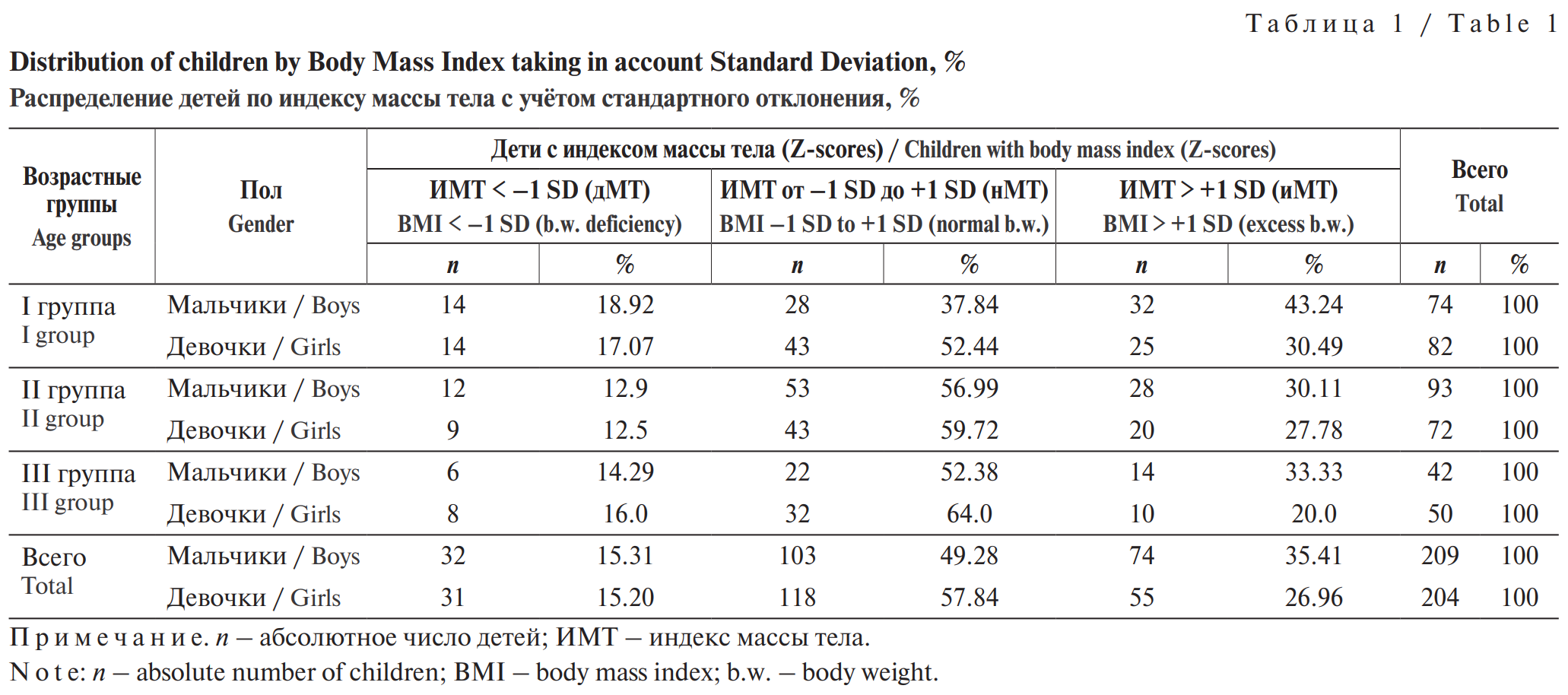
The respondents included 209 boys and 204 girls. The children were divided into three age groups and gender subgroups: Group I (n = 156, 74 boys and 82 girls, ages 7–10), with a mean age of 8.54 years for boys and 8.67 years for girls; Group II (n = 165, 93 boys and 72 girls, ages 11–14), with a mean age of 12.44 years for both boys and girls; Group III (n = 92, 42 boys and 50 girls, ages 15–17), with a mean age of 15.73 years for boys and 15.70 years for girls. Distribution by ethnic affiliation: 58.11% of respondents identified as Soyots, 40.19% of children considered themselves Buryats, and 1.7% indicated affiliation with the Slavic ethnic group.
Anthropometric measurements in children were performed using the standardized method developed by A.B. Stavitskaya and D.I. Aron with calibrated equipment [16]. Nutritional status was assessed using body mass index (BMI) and age-specific BMI Z-scores calculated using the sigma method in accordance with the WHO standards [17]; the use of these standards was necessitated by the children’s diverse ethnic backgrounds, which is characteristic of the population of the Baikal region. In accordance with methodological recommendations², the authors classified children into the normal weight (nW) subgroup when the sigma deviation of their actual BMI from the arithmetic mean did not exceed ±1 SD. The underweight (UW) subgroup included children with a BMI of less than –1 SD, while the overweight (OW) subgroup included children with a BMI of more than +1 SD. The data obtained on the intake of major nutrients and the calculated values of the optimal ratio of these nutrients to energy intake (EV) of the diet were compared with the standards for physiological requirements according to the Methodological Recommendations³.
Statistical analysis was performed using the Statistica v.6.0 software package for Windows. The obtained sample was tested for normality of distribution using the skewness and kurtosis coefficients. The results were presented as the mean centile trend (Me), the 25th percentile (P25), and the 75th percentile (P75). The collected data were analysed using the nonparametric Mann–Whitney U test. The statistical significance level was set at p < 0.05.
Results
Groups I, II, and III of children were divided into subgroups based on anthropometric measurements, BMI Z-scores, and age. The distribution is presented in Table 1.
An assessment of the optimality of the macronutrient ratio in the energy composition of children’s actual diets (Table 2) showed that the proportion of protein in the diet’s energy composition was optimal. The exception was the diet of underweight girls in Group II (ages 11–14), for whom the proportion of protein in the energy intake [Ме (Р25–Р75)] was 10.33% (10.27–10.75%), which is below the physiological norm³. At the same time, the children’s diets showed a deficiency of total carbohydrates in the energy content, accompanied by an excess of total fats, saturated fatty acids (SFAs), ɷ -6 polyunsaturated fatty acids (PUFAs), and added sugars.
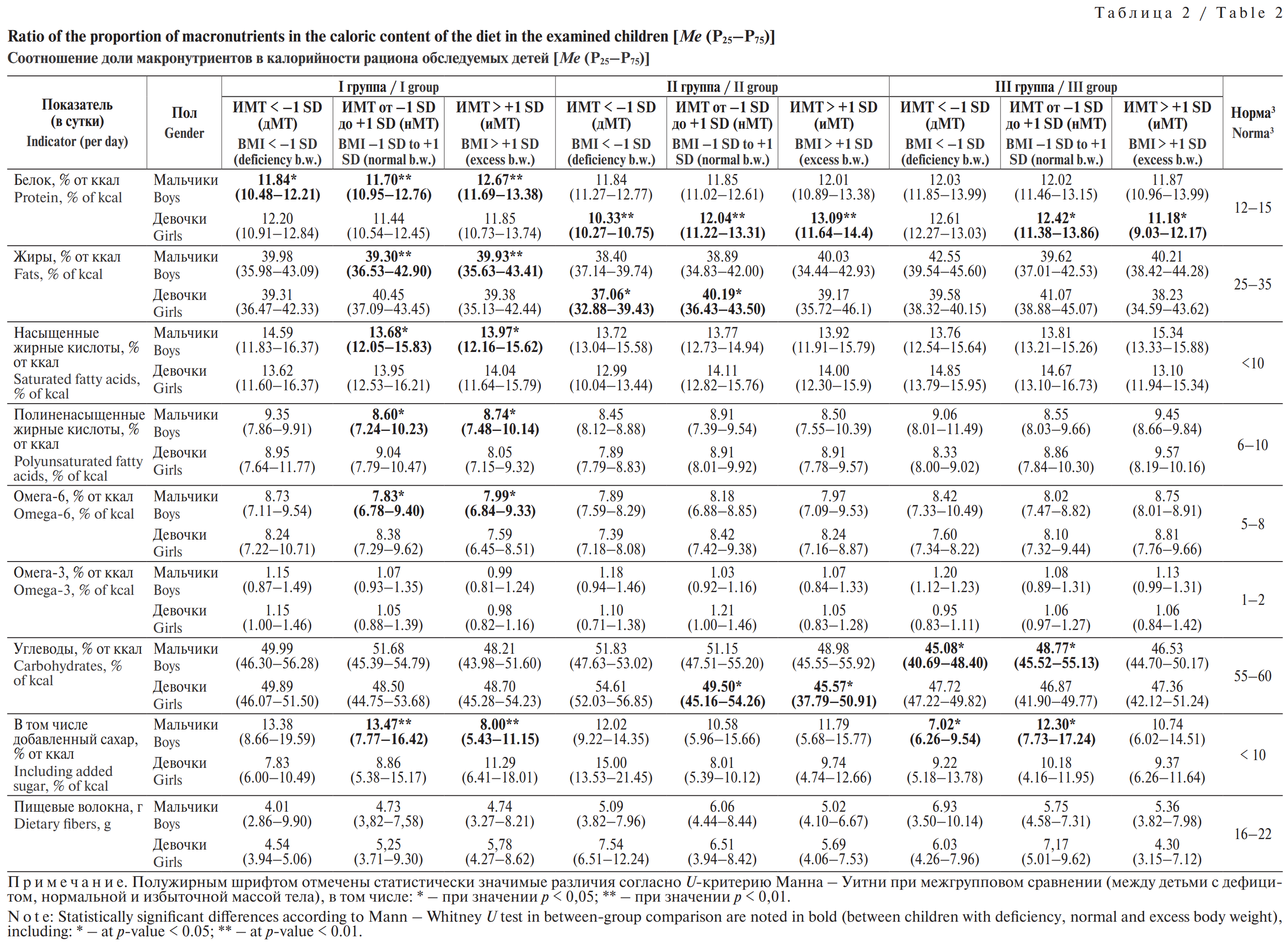
The median share of protein in the dietary energy intake of overweight boys in Group I aged 7–10 years was higher, according to the Mann–Whitney U test, than what was recorded for boys with normal weight (p < 0.01) and underweight boys (p < 0.05) of the same group; a similar ratio was observed among girls in Group II aged 11–14 years (p < 0.01). Among girls in Group III aged 15–17 years with normal weight the share of protein in the dietary energy intake was higher than among overweight girls of the same group (p < 0.05).
An excess of fat in the dietary energy intake was observed in all gender subgroups of children, as compared to the upper limit of the required physiological norm³: 1.1–1.2 times; 1.3–1.5 times for saturated fatty acids. The share of total fat (Me) in the dietary energy intake of overweight boys in Group I aged 7–10 years was higher than for those with normal weight (p < 0.01); for girls in Group II aged 11–14 years with normal weight, it was higher than for those, who were underweight (p < 0.05). The shares of saturated fatty acids, polyunsaturated fatty acids, and ɷ -6 polyunsaturated fatty acids in the dietary energy intake of boys in Group I aged 7–10 years with high BMI were higher than in the diet of boys with normal BMI (p < 0.05).
The lipid profile of the children’s diet showed an optimal share of PUFAs in total energy intake, but with an imbalance in the ratio of ɷ-3 to ɷ-6 PUFAs. According to the required physiological norms³, their ratio should be 1:4 – 1:5; in fact, for boys it ranged from 1:6.7 to 1:8.1, and for girls from 1:6.7 to 1:8.3. The results indicate an excess of ɷ -6 PUFAs, since the proportion of ɷ -3 PUFAs was within the range of the required physiological norms³.
A deficiency of total carbohydrates in the energy content of the diets is observed in Group I (ages 7–10) for boys with normal weight and overweight boys; in Group II (ages 11–14) for underweight boys; and in Group III (ages 15–17) for underweight and overweight boys, where Ме (Р25–Р75) is 1.1–1.2 times lower than the lower limit of the normal range for the required physiological norms³; in girls, this deficiency is observed in all groups and subgroups, also by a factor of 1.1–1.2, with the exception of underweight girls in Group II (ages 11–14). The amount of dietary fiber in the diet of all gender and age groups was 2.65–5.12 times below the norm³. The median proportion of added sugar in the dietary energy intake of children exceeded the standard for physiological needs³ in all groups and subgroups, with the exception of the underweight boys in Group III aged 15–17, where this indicator was 7.02% (6.26–9.54%) of the energy intake. The highest excess in the proportion of added sugar was observed in the dietary intake of boys in Group I aged 7–10 years with normal body weight – 1.4 times the norm – and in the underweight girls in Group II aged 11–14 years – 1.5 times the standard. In an intergroup comparison, the share of total carbohydrates in the dietary energy intake of boys in Group III aged 15–17 years with normal body mass index (nBMI) was higher than in the diet of underweight boys (p < 0.05), and among girls in Group II aged 11–14 with normal BMI, it was higher than among girls with overweight (p < 0.05). The proportion of added sugars in the dietary energy intake of boys in Group I aged 7–10 with normal BMI was higher than among boys with overweight (p < 0.01). In the age group of boys aged 15–17 years with normal BMI, the proportion of added sugar in the dietary energy intake was higher than in boys with underweight (p < 0.05).
Excess salt intake can also be considered an important aspect of children’s actual dietary intake. The measured sodium (Na) content in the respondents’ diets was converted to the equivalent salt content [18]. According to the calculations, the salt content in the boys’ diets is 1.15 times higher than the recommended dietary intake limits⁴ (1.8 kg/year/person) and amounts to 2.07 kg/year/person, while in girls’ diets it is 1.07 times higher (1.93 kg/year/person). Despite the actual excess of salt in their diets, when asked “Do you add salt to your food?”, 61.17% of boys and 70.71% of girls answered “never.”
It is interesting to note that the children’s diet includes sarlyk and venison, which have traditionally been consumed by the population of the Okinsky District of the Republic of Buryatia [12, 13]. These foods were present in the diet more than once a week for 44.98% of boys and 31.86% of girls aged 7–17 years. It was also found that 43–44.5% of respondents prefer frying as a cooking method, and 74.43–83.65% of children consume mayonnaise daily, even though it is not permitted in children’s diets.
Discussion
The study indicates a predominance of a lipid-rich dietary pattern with insufficient dietary fiber, which creates an imbalance of nutrients critical to health in the diets of children living among the small indigenous peoples of Siberia. The optimal share of protein and polyunsaturated fatty acids (PUFAs) in the dietary energy intake for all age groups of children is primarily due to the consumption of meat and dairy products, which is not observed in the diets of school-age children living in industrial centres of Western [19] and Eastern Siberia [15, 20]. Maintaining the customary level of consumption of these foods in the diet will contribute to the intake of optimal amounts of macronutrients and micronutrients, as well as to the preservation of children’s health, which is consistent with the data from S.V. Andronov et al. (2020), which indicate the risk of transitioning to a modern diet among the indigenous population of the Arctic region of Western Siberia [21].
At the same time, the existing imbalance in the lipid profile of children’s diets – caused by an excess of saturated fatty acids and omega-6 polyunsaturated fatty acids, as well as a suboptimal ratio of omega-6 to omega-3 PUFAs – is primarily associated with excessive consumption of foods containing fats of plant and animal origin. The data obtained in our study show that the proportion of children who consume mayonnaise daily is 2.1–2.4 times higher than the corresponding figures in the Orenburg Region, where 35.5% of schoolchildren consume mayonnaise daily [22], and 5.9–6.7 times higher compared to the diet of children living in Angarsk, Irkutsk Oblast – 12.6% [15].
The diets of the children, we surveyed in all subgroups, show a carbohydrate deficiency due to a severe lack of dietary fiber, which is associated with low consumption of vegetables and fruits. The excess of added sugar noted in the study’s results does not offset the deficiency in total carbohydrates. This situation is characteristic not only of children living in areas inhabited by small ethnic groups but also in the industrial centres of Eastern Siberia [15, 20]. At the same time, the severity of dietary fiber deficiency is more pronounced in the groups of children we examined. The deficiency of fruits and vegetables in the diet is due to their insufficient physical and economic accessibility; among the main causes, it is important to highlight the lack of a developed transportation and logistics infrastructure, as well as the inability to grow vegetables due to extreme natural and climatic conditions and soil characteristics [12, 13].
The causes of overweight and obesity are diverse and cannot be reduced to overeating alone. Scientists do not dispute the contribution of inherited genetic and epigenetic factors to the predisposition to overweight and obesity in children [6, 23, 24]. Studying family dietary habits and traditions provides a deeper understanding of how hereditary genetics and epigenetics can create a “fat‑genetic environment” in childhood [25, 26]. Studies by H.H. Maes et al. (1997) [27] in families of twins and adopted children have shown that the heritability of obesity ranges from 40% to 70%, while the presence of these genes increases the risk of obesity but is not its cause. The “fat‑genetic environment” contributes to overweight and obesity: insufficient physical activity and sleep, excessive calorie intake, microbiome composition, endocrine-disrupting chemicals, socioeconomic status, ethnic affiliation, psychosocial stress, and others [28–30].
It is possible to assume that the greatest imbalance in critically important nutrients identified by us, observed in the diet of children in Group I aged 7–10 years, led to a higher proportion of overweight children (43.24% among boys and 30.49% among girls) in this group. In Groups II and III, among children aged 11 to 17, this indicator is balanced out. It should be noted that a suboptimal diet in children with normal body mass index may subsequently lead to a risk of becoming overweight, and in underweight children – to a higher risk of developing metabolic syndrome in adulthood.
Study Limitations. The main limitation is that the information obtained from respondents may contain errors, as it depends on the completeness of their responses to the survey. The data reflect the status of the study group of children only during a specific period, as they were collected through a single-point survey, which does not allow for an unequivocal determination of the causes of overweight and obesity – most of which are multifactorial in nature and require further research.
Conclusion
The presented analysis of the actual dietary habits of school-aged children living in the territories of small indigenous peoples of Siberia indicates both similarities to the dietary structure of children living in industrial centres and distinctive features. Despite the optimal protein content in the children’s diet, the consumption of critically important nutrients (fat, added sugar, and table salt) exceeds physiological norms; therefore, the diet should be oriented toward a traditional model with appropriate adjustments to the consumption of foods that are sources of high-molecular-weight plant-based carbohydrates, as well as towards a low content of fats, added sugars, and table salt.
The identified characteristics of the actual dietary patterns of children living in extreme climatic conditions require coordinated efforts by an interdisciplinary team of experts and the community as a whole to find an adequate solution for implementing preventive measures aimed at promoting optimal nutrition.
1. Tutelyan V.A., Nikityuk D.B. Key challenges in the dietary intake structure and cutting edge technologies for optimizing nutrition to protect the health of the Russian рopulation. Voprosy pitaniya. 2024; 93(1): 6–21. https://doi.org/10.33029/0042-8833-2024-93-1-6-21 https://elibrary.ru/xcdqzj (in Russian)
2. Onishchenko G.G., Zaitseva N.V., Popova A.Yu., Mai I.V., Ustinova O.Yu., Trusov P.V., et al. Health Risk Analysis in Public Socio-Economic Development Strategy. Volume 1 [Analiz riska zdorov’yu v strategii gosudarstvennogo sotsial’no-ekonomicheskogo razvitiya. Tom 1]. Moscow; 2024. https://elibrary.ru/vofelz (in Russian)
3. Popov V.I., Milushkina O.Yu., Skoblina N.A., Nikolenko V.N. Standardization of studies on physical development of children in the Russian Federation. Kazanskii meditsinskii zhurnal. 2024; 105(6): 1015–22. https://doi.org/10.17816/KMJ633448 https://elibrary.ru/feiuqm (in Russian)
4. NCD Risk Factor Collaboration (NCD-RisC). Worldwide trends in underweight and obesity from 1990 to 2022: a pooled analysis of 3663 population-representative studies with 222 million children, adolescents, and adults. Lancet. 2024; 403(10431): 1027–50. https://doi.org/10.1016/S0140-6736(23)02750-2
5. Popova A.Yu., Shevkun I.G., Novikova I.I., Romanenko S.P. Main results of nutrition monitoring of school-age children implemented within the framework of the federal project «Public Health Improvement» of the national project «Demography». Voprosy pitaniya. 2025; 94(1): 64–70. https://doi.org/10.33029/0042-8833-2025-94-1-64-70 https://elibrary.ru/uumwtq (in Russian)
6. Martinchik A.N., Laikam K.E., Kozyreva N.A., Mikhailov N.A., Keshabyants E.E., Baturin A.K., et al. Prevalence of overweight and obesity in children. Voprosy pitaniya. 2022; 91(3): 64–72. https://doi.org/10.33029/0042-8833-2022-91-3-64-72 https://elibrary.ru/vaqojc (in Russian)
7. Spirin V.F., Milushkina O.Yu., Eliseeva Yu.V. Socio-hygienic and behavioral trends touching upon the quality of life of adolescents. Gigiena i Sanitaria (Hygiene and Sanitation, Russian journal). 2022; 101(6): 683–7. https://elibrary.ru/szlloi (in Russian)
8. Baturin A.K., Pogozheva A.V., Keshabyants E.E., Soto S.H., Kobelkova I.V., Kambarov A.O. Features of the chemical composition of the diet and nutritional status of indigenous and newcomers in the Russian arctic. Gigiena i Sanitaria (Hygiene and Sanitation, Russian journal). 2019; 98(3): 319–23. https://elibrary.ru/vvinhz (in Russian)
9. Gritsinskaya V.L. Nutritional status of students living in different regions of Russia. Rossiiskii pediatricheskii zhurnal. 2022; 3(1): 100. https://elibrary.ru/ekyjvr (in Russian)
10. Astakhova T.A., Rychkova L.V., Pogodina A.V., Mandzyak T.V., Klimkina Yu.N. Comparative analysis of health status of adolescents of different ethnic groups in Buryat republic. Ekologiya cheloveka. 2017; (6): 24–9. https://doi.org/10.33396/1728-0869-2017-6-24-29 https://elibrary.ru/yunokn (in Russian)
11. Balabina N.M., Bezgodov I.V., Belykh A.I., Bogdanova O.G., Boeva A.V., Efimova N.V., et al. Preventive Medicine. Actual Medical and Environmental Problems of Siberia [Profilakticheskaya meditsina. Aktual‘nye mediko-ekologicheskie problemy Sibiri]. Irkutsk; 2022. https://elibrary.ru/cuqqwx (in Russian)
12. Kurdjukov V.N. Traditional economy Soyote and its dynamics. Izvestiya Irkutskogo gosudarstvennogo universiteta. 2021; 5(1): 176–85. https://elibrary.ru/oyrjtl (in Russian)
13. Mongush M.V. The Tophas and the Soyots: historical and ethnographic essay. Novye issledovaniya Tuvy. 2012; (2): 62–78. https://elibrary.ru/piqlmr (in Russian)
14. Damshaeva L.K. The role of state national policy in the revival of Soyot. Mezhdunarodnyi zhurnal gumanitarnykh i estestvennykh nauk. 2020; (12–1): 119–22. https://elibrary.ru/xkxfpq (in Russian)
15. Tarmaeva I.Yu., Pyrieva E.A., Gmoshinskaya M.V., Bogdanova O.G., Tkachuk E.A., Netunaeva E.A., et al. Nutritional features of school children in the Siberian federal district. Meditsinskii sovet. 2021; (17): 264–71. https://doi.org/10.21518/2079-701X-2021-17-264-271 https://elibrary.ru/dmpefh (in Russian)
16. Bogdanova O.G., Mylnikova I.V., Urbanova E.Z., Tarmaeva I.Yu. Peculiarities of length-weight somatometric indices in school-age children of the industrial center. Gigiena i Sanitaria (Hygiene and Sanitation, Russian journal). 2024; 103(9): 992–8. https://doi.org/10.47470/0016-9900-2024-103-9-992-998 https://elibrary.ru/qdzazw (in Russian)
17. WHO. Child growth standards; 2006. Available at: https://who.int/tools/child-growth-standards
18. WHO. Guideline: Sodium intake for adults and children; 2012. Available at: https://who.int/publications-detail-redirect/9789241504836
19. Tapeshkina N.V., Logunova T.D., Korsakova T.G., Pestereva D.V. Analysis of actual nutrition of schoolchildren over different age periods of lifeanalysis of actual nutrition of schoolchildren at different age periods. Gigiena i Sanitaria (Hygiene and Sanitation, Russian journal). 2024; 103(4): 342–8. https://doi.org/10.47470/0016-9900-2024-103-4-342-348 https://elibrary.ru/vldiqq (in Russian)
20. Bogdanova O.G., Efimova N.V., Mylnikova I.V. Comparative nutritional characteristics in schoolchildren with different nutritional status. Gigiena i Sanitaria (Hygiene and Sanitation, Russian journal). 2022; 101(9): 1072–9. https://doi.org/10.47470/0016-9900-2022-101-9-1072-1079 https://elibrary.ru/wordpf (in Russian)
21. Andronov S.V., Lobanov A.A., Bichkaeva F.A., Popov A.I., Fesyun A.D., Mukhina A.A., et al. Traditional nutrition and demography in the arctic zone of western Siberia. Voprosy pitaniya. 2020; 89(5): 69–79. https://elibrary.ru/ulizlt (in Russian)
22. Mironova M.S., Plotnikova E.G., Neplokhov A.A., Degtyareva E.V., Guselnikova E.M. Specific aspects of nutrition and health status of children in the Orenburg region. Orenburgskii meditsinskii vestnik. 2024; 12(3): 42–5. https://elibrary.ru/vaatcf (in Russian)
23. Panera N., Mandato C., Crudele A., Bertrando S., Vajro P., Alisi A. Genetics, epigenetics and transgenerational transmission of obesity in children. Front. Endocrinol. (Lausanne). 2022; 13: 1006008. https://doi.org/10.3389/fendo.2022.1006008
24. Lizalde Hernández A., Moreno González M.M., Vestena Zillmer J.G., Guzmán Ortíz E., Valenzuela Gandarilla J. Meanings that mothers of obese children attribute to eating habits: grounded theory. Rev. Esc. Enferm. USP. 2025; 59: e20240330. https://doi.org/10.1590/1980-220X-REEUSP-2024-0330en
25. Jia P. Obesogenic environment and childhood obesity. Obes. Rev. 2021; (22 Suppl. 1): e13158. https://doi.org/10.1111/obr.13158
26. Mei K., Huang H., Xia F., Hong A., Chen X., Zhang C., et al. State-of-the-art of measures of the obesogenic environment for children. Obes Rev. 2021; 22(Suppl. 1): e13093. https://doi.org/10.1111/obr.13093
27. Maes H.H., Neale M.C., Eaves L.J. Genetic and environmental factors in relative body weight and human adiposity. Behav. Genet. 1997; 27(4): 325–51. https://doi.org/10.1023/a:1025635913927
28. Blanco M., Veiga O.L., Sepúlveda A.R., Izquierdo-Gomez R., Román F.J., López S., et al. Family environment, physical activity and sedentarism in preadolescents with childhood obesity: ANOBAS case-control study. Aten. Primaria. 2020; 52(4): 250–7. https://doi.org/10.1016/j.aprim.2018.05.013 (in Spanish)
29. Lee H., La I.S. Latent class analysis of obesogenic behaviors among Korean adolescents: associations with weight-related outcomes. Int. J. Environ. Res. Public Health. 2021; 18(21): 11059. https://doi.org/10.3390/ijerph182111059
30. Masood B., Moorthy M. Causes of obesity: a review. Clin. Med. (Lond.). 2023; 23(4): 284–91. https://doi.org/10.7861/clinmed.2023-0168
DSc (Medicine), associate professor, senior researcher, Laboratory of environmental and hygienic research, East-Siberian Institute of Medical and Ecological Research, Angarsk, 665826, Russian Federation
e-mail: olga.bogdanova2001@gmail.com
PhD (Medicine), head, Risk factor monitoring department, Center for Public Health and Medical Prevention of the Republic of Buryatia named after V.R. Boyanova, Ulan-Ude, 670034, Russian Federation
e-mail: urbanova8484@mail.ru
DSc (Medicine), associate professor, senior researcher, Laboratory of environmental and hygienic research, East-Siberian Institute of Medical and Ecological Research; Angarsk, 665826, Russian Federation
e-mail: inna.mylnikova.phd.ms@gmail.com
Laboratory research assistant, Laboratory of environmental and hygienic research, East-Siberian Institute of Medical and Ecological Research; Angarsk, 665826, Russian Federation
e-mail: nayeon.son.son@gmail.com
Bogdanova O.G., Urbanova E.Z., Mylnikova I.V., Mokhosoeva A.A. Characteristics of actual nutrition and its specificity in the child population, taking into account the territory of residence. Hygiene and Sanitation. 2026;105(5):553-559. https://doi.org/10.47470/0016-9900-2026-105-5-553-559. EDN: bznzyi
Мы в ВК:

 Email this article (Login required)
Email the author (Login required)
Email this article (Login required)
Email the author (Login required) 141014, The Moscow region, Mytishchi, 2, Semashko street
Federal Scientific Center of Hygiene named after F.F. Erisman
Phone: +7 916 885 28 02
e-mail: gigsan@list.ru